 Sidney Alfred Parsons and his Ancestors
William Newlyn (1751 to 1834)
William Newlyn’s daughter Faith married John Boyes of Owslebury and William was a great-grandfather of Harriet Eliza Boyes who became the wife of John Parsons the Southampton publican. William was therefore a great-great-grandfather of John’s son Sidney Parsons who was a grandfather of the author of this web page.
William was born in the parish of Easton, which lies by the River Itchen a few miles north east of the city of Winchester, but he was baptised several miles further upstream in Ovington. His parents were John Newlyn and Mary Complyn. An entry was made in the Easton parish register noting the baptism.
William’s earliest known Newlyn ancestors had lived in the Parish of Tichborne which is only a few miles from both Ovington and Easton. Some information about tham can be obtained by clicking on the following link — The Newlyn family of Tichborne.
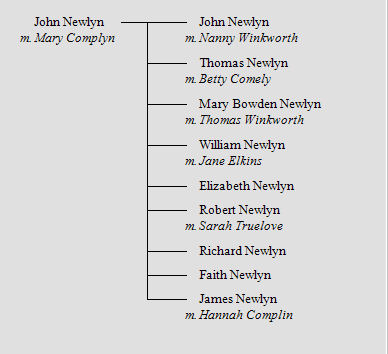
William was his parents’ fourth child and their third son. He had two older brothers, John and Thomas, and an older sister, Mary.
In 1755, when William was about four years old, the family left Easton and went to live in Compton, just south of Winchester. They lived at New Barn Farm which William’s father leased from Sir Thomas Heathcote, the third Baronet of Hursley. William’s father kept some of his land in Easton and he also farmed land in Owslebury, a mile or two from Compton.
Compton was a tiny village when the Newlyn family moved there. The Universal British Directory of 1794, forty years later, listed just two large farms and one small one. The biggest was occupied by the Goldfinch family who were relatives of William’s grandmother Elizabeth Complyn and they had lived there at least since the Civil War. New Barn Farm, William’s father’s, was the other large farm. The main occupants of the village other than the Newlyns and the Goldsmiths were a maltster, a publican and the rector.
William grew up in Compton but when he was a young man he moved to the suburbs of London where he lived in Clapham. It is not known why William moved there, nor what he did for a living. It is tempting to speculate that he was involved in the brewing trade as his eldest son later became a maltster. William could have learnt the business from the maltster in Compton. Or perhaps he was involved in the timber trade. The family lands in Hampshire were well stocked with timber and there would have been a great deal of building work in the London suburbs. Clapham at that time was a leafy suburb with many large country houses and was favoured by the wealthier merchant classes of the City of London.
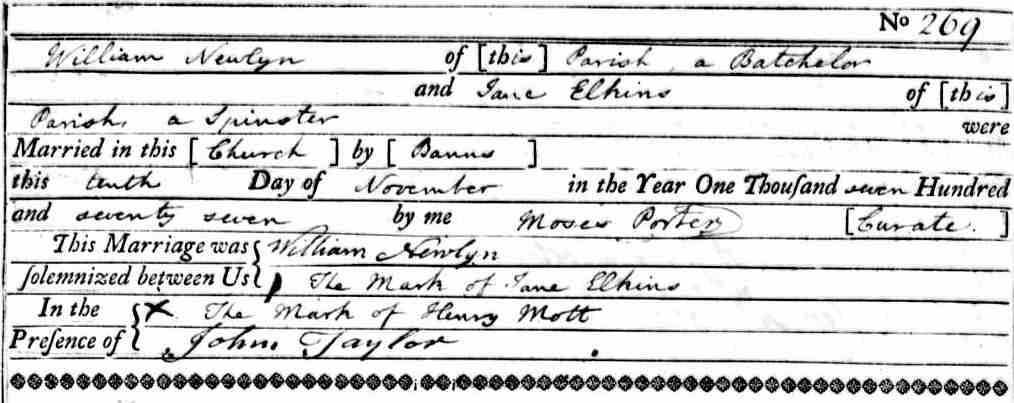
William got married while he was living in Clapham. His bride was Jane Elkins who had probably originally come from Owslebury, not far from his
home in Hampshire. The ceremony was held in the newly constructed Church of the Holy Trinity on the 10th of November 1777.
A copy of the marriage entry in the parish register is shown on the right.
William and Jane’s first three children were born while they were living in Clapham. Their first two, William and Faith, were baptised at Stockwell Chapel but the third, John, was baptised at Saint Mary’s Church, Lambeth. Faith was later to become the wife of John Boyes of Owslebury and she has her own biographical web page.
In about 1787 William and Jane returned to Hampshire with their family and lived in Owslebury, Jane’s home village, where William’s
father still owned land. They had four more children while they lived there: James, Richard, Elizabeth and Peter.
William’s father John Newlyn died in 1796. His eldest son, John, had already died and his second son, Thomas, lived in the farm house in Compton with his wife Betty. William received a generous inheritance. Just three years later William’s brother Thomas died leaving William most of the land which had been their father’s.
William continued to farm in Owslebury and early in 1801 he was the victim of theft. A man called Richard Carter was imprisoned for six months for stealing three trusses of hay from him.

In 1804 William placed an adverisement in the Hampshire Chronicle offering a house for let in Upham, a parish which adjoins Owslebury. It read:
“To be Let, and Entered on immediately, for a Term of Years, A SMALL GENTEEL COTTAGE, consisting of One Parlour, Two Kitchens, Pantry,
and Cellar, and Five Chambers, a Garden, and Five Acres of LAND, if required, situate in the Parish of Upham, near Bishop's Waltham, in Hampshire.
For further Particulars apply to Mr. Wm. Newlyn, of Owslebury.
It is not known whether or not William succeeded in letting that house, but a few years later William and his family were living in Upham. The house in which they lived is still there and is pictured on the right.
In 1812, only a few years after moving to Upham, it seems that William wanted to raise some cash and
retire from farming. He tried to sell his
main house and land by auction and placed the following advertisement in the Salisbury and Winchester Journal:
HANTS.
Valuable COPYHOLD and FREEHOLD LANDS,
In the Parishes of Upham and Owslebury,
Containing by estimation 123 Statute Acres (more or less).
TO be SOLD by AUCTION, By Wm.Weston (Successor to Mr. J.Limpus), in one lot, on Wednesday, March 11, 1812, at the Crown Inn,
Bishop’s Waltham, between the hours of three and six in the afternoon, subject to such conditions as will be then and there produced,
(unless previously disposed of by Private Contract, of which due notice will be given), — All that valuable and compact COPYHOLD and
FREEHOLD ESTATE, consisting of 36 Acres of Copyhold Lands, held under the Manor of Bishop’s Waltham; with a substantial brick-built
DWELLING HOUSE, consisting of two front parlours, six bed-chambers, good kitchen, pantry, cellar, and brewhouse, with a Garden and Cottage adjoining,
near which is a spring of excellent water which may easily be conveyed to the house; Barns, new Stables, and all other necessary outbuildings,
in excellent repair, fit for the reception of a genteel family, situated in the pleasant village of Upham, commanding an extensive view of the
Isle of Wight, Southampton Water, and adjacent country; together with about 46 Acres of Freehold Lands adjoining; and about 41 Acres of Copyhold Lands,
with a Barn, situate in the parish of Owslebury, held under the Manor of Marwell; the whole being arable lands, in a state of cultivation, having
unlimited rights on Owslebury Down, Colden Common, and Stroud Wood.
The whole may be viewed, and particulars known, by applying to Mr. W.Newlyn, the proprietor, on the premises.
Upham is situated 7 miles from Winchester, 3 from Bishop’s Waltham, 9 from Alresford, and 10 from Southampton, in a fine sporting
country, and in the immediate neighbourhood of a pack of fox-hounds.
Possession to be had at Michaelmas next. — Part of the purchase money may remain on mortgage, if required.
Perhaps the reserve price at the auction was not met because the sale did not go ahead, although either then or over the next two years William did dispose of some of his freehold land.
William was a relatively wealthy man but his wealth was in property and it seems that ready cash was in short supply. He was getting into debt. In 1815 he again tried to sell his house and land, but this time in several lots. One of the lots included a smaller dwelling house in Baybridge, between Upham and Owslebury, which had not been included in the auction of 1813. The full text of this advertisement can be read by clicking on the following link — Advertisement in the Salisbury and Winchester Journal, 13thMarch, 1815.
Whatever the outcome of the 1815 auction, in 1818 William was still paying rent to the Manor of Marwell for his 34 acres of land in the parish of Owslebury.
Late in 1820 or early in 1821 William was imprisoned for not not paying his debts. Under the insolvent Debtors (England) Act 1813 anyone imprisoned could apply to the court to be released after reaching an agreement with their creditors. William’s petition to the court in Winchester was heard on the 31st of March 1821 and he was released.
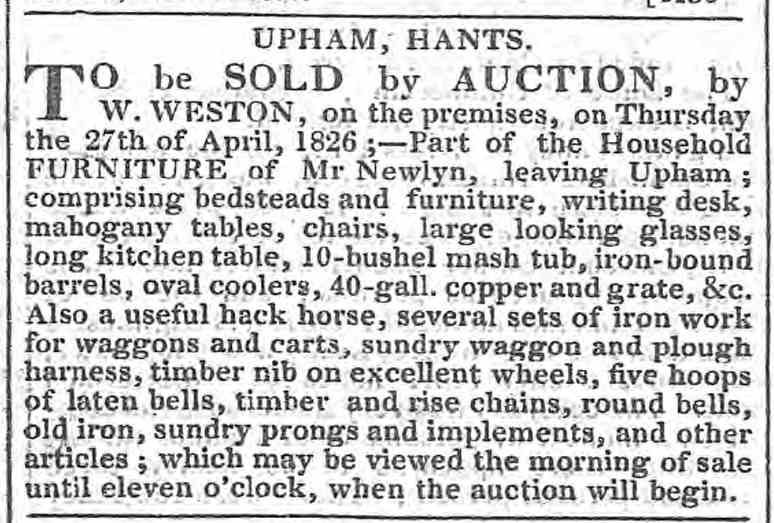
Five years later, in April 1826, William put many of his household effects up for auction saying that he intended to leave Upham. A copy of the advertisement can be seen on the right. He also sold a piece of land called Yalton Field which was near near Stephens Castle.
In fact, William did not leave Upham. He was still living there when he died two years later in May 1828, aged 77 years. He left no will and his widow Jane and his son Thomas were appointed as administrators of his estate. Jane continued to live in Upham until she died seven years later.
Children of William and Jane Newlyn
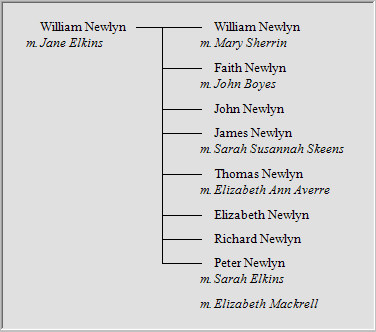
William and Jane had eight children. They were :
• William, who was baptised at the Stockwell Chapel in Lambeth, London on the 2nd of July 1780. He was about six years old when his parents moved to Owslebury and he grew up there and became a maltster by trade. He was obviously considered to be a capable young man because when his uncle James Newlyn, of Wonston, died in 1810, James’ will named William as the executor. On the 11th of December 1810 William married Mary Sherrin in Ashe, a village just over the county border in Surrey, near Aldershot. (Ashe is today spelt without the final “e”.) William and Mary lived in Ashe and had three children - William, Mary and Thomas - but in 1819 their mother Mary died when she was only 35 years old. The following year William had his two youngest children baptised in Upham where his father was then living. After then nothing more is known of William. One of William and Mary’s sons, William, emigrated to Australia. Young William was baptised in Upham in December 1811. He went to live in London where he worked for a brewery, and there he married Eliza Barnett. In April 1856 William and Eliza departed for Sydney, New South Wales, on the James Fernie, accompanied by their eight children.
• Faith was baptised on the the 25th of August 1852, also at the Stockwell Chapel. She was still a young girl when her parents moved back to Hampshire and she grew up in Owslebury. When she was nineteen years old she married John Boyes, a local farmer, and one of her sons, William Boyes became a grandfather of Sidney Parsons. Faith lived the rest of her life in Owslebury until she died there on Christmas day in 1860. Faith has her own biographical web page.
• John was baptised in Lambeth, London, on the 27th of March 1785. The details of his life are a bit of a mystery. Nothing is known of him until in 1861 he was recorded living in Portsmouth, at the Portsea Island Union Workhouse, where he was said to be a widower and a retired agricultural labourer. He died in about February 1862.
• James was the first of William and Jane’s children to be born in Hampshire. He was baptised in Owslebury on the 24th of June 1787. As an adult James moved further south to the area of Hampshire between Portsmouth and Southampton and there, in Alverstoke, he married Sarah Susannah Skeens in February 1826. A year later their first child, Sarah, was baptised in Upham, where his parents were then living. James became a farm bailiff and the family lived at Peel Common, not far from Alverstoke. Their two other children, Ellen and Faith, were baptised in the parish church, which was at Titchfield, in 1831 and 1834 respectively, but Faith died while she was still a child. James died at Room Farm in Peel Common, in April 1875. James and Sarah’s daughter Sarah had married a coal merchant called James Lock and lived with him at Lower Quay, Fareham. After James died his widow Sarah went to live with Sarah in Fareham until she died in 1878. Her other daughter Ellen became a housemaid in Fareham, first in Osborn Road and later at no.28 West Street.
• Thomas was baptised in Owslebury on the 13th of September 1789. He became a timber merchant in London (there was a good supply of timber on his father’s land) and there, in 1838, he married Elizabeth Anne Averre. Elizabeth was nineteen years younger than he was and she was a widow. The family moved back to Thomas’s home village of Upham and there they had two children: Jane, born in 1840 and Sophia, born in 1842. Thomas farmed in Upham for a few years but then the family moved back to London where they lived in Marylebone and Thomas worked as a land surveyor. After Thomas retired Elizabeth worked as a laundress and she continued to do so after he died. Their two daughters never married. The eldest, Jane, became a servant and then secured a post as a lady’s maid at Weelsby House, a large house near Grimbsby in Lincolnshire. When her father died she went back home to live with her mother and sister for a while but then took a job in Dorset. Jane lived at Furzebrook House near Wareham and, the owners being absent, her rôle as housekeeper was to supervise the other servants. There were clay pits in the Furzebrook estate and one of them has now become the popular tourist attraction known as The Blue Pool. When Jane retired she went back to London and lived in Camden Town. She died there in 1924. Sophia, Thomas and Elizabeth’s younger daughter, lived at home with her mother and worked as a dressmaker. After her mother died Sophia continued to live in the same house until her own death in 1917.
• Elizabeth was born in Owslebury and baptised there on the 16th of October 1791. At present, nothing more is known about her.
• Richard died young. He was baptised in Owslebury on the 12th of January 1794 and he was buried there on the 14th of November 1808 when he was only about fifteen years old.
• Peter was William and Jane’s youngest child. He was also born in Owslebury and was baptised there on the 29th of April 1798. Like his brother Thomas, Peter went to work in London and there, in Lambeth, on the 7th of December 1824, he married Sarah Elkins. (Sarah might well have been one of his mother’s relatives, the Elkins family in Owslebury.) Sarah soon died and a few years later Peter married again. His second wife was Elizabeth Mackrell, a London girl who was was living in Lambeth at the time. Peter and his wife moved to Chalfont St.Giles in Buckinghamshire where he became involved in setting up a building society (it was the ERA Building Society and he became its secretary). He became a minister of religion based at the Chalfont Independent Chapel. Peter and Elizabeth spent the rest of their lives in Chalfont St.Giles. They had no children but in later life they adopted a young boy called John Keen. Richard died in October 1879.
Ancestors of William Newlyn
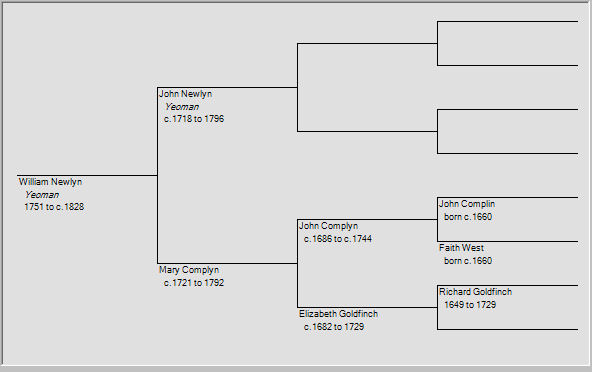
Parents
Father — John Newlyn
Mother — Mary Complyn
Grandparents
Grandfather — John Complyn of Morestead and North Baddesley
Grandmother — Elizabeth Goldfinch of Compton
Great-grandparents
Great-grandfather — John Complyn of Morestead
Great-grandmother — Faith West
Great-grandfather — Richard Goldfinch of Compton
Great-grandmother — unknown
Return to Sidney Parsons’ Ancestors
You are free to make use of the information in these web pages in any way that you wish but please be aware that the author, Mike Parsons, is unable to accept respsonsibility for any errors or omissions.
Mike can be contacted at parsonspublic@gmail.com
The information in these web pages comes from a number of sources including: Hampshire County Records Office, Somerset Heritage Centre; Dorset County Records Office; Southampton City Archives; the General Register Office; several on-line newspaper archives; several on-line transcriptions of Parish Register Entries; and several on-line indexes of births, marriages and deaths. The research has also been guided at times by the published work of others, both on-line and in the form of printed books, and by information from personal correspondence with other researchers, for all of which thanks are given. However, all of the information in these web pages has been independently verified by the author from original sources, facimile copies, or, in the case of a few parish register entries, transcriptions published by on-line genealogy sites. The author is aware that some other researchers have in some cases drawn different conclusions and have published information which is at variance from that shown in these web pages.
Copyright © 2013 Mike Parsons. All rights reserved.