 Sidney Alfred Parsons and his Ancestors
William Boyes (1807 to 1886)
William was the maternal grandfather of Sidney Parsons who was a grandfather of the author of this web page. William’s daughter Harriet Eliza married the publican John Parsons who as a young man had moved to Southampton from his home in Somerset, and Sidney was their second son.
William Boyes was born a few miles south east of Winchester in Hampshire in the hamlet of Hensting, between Colden Common and Owslebury, and he was baptised in Owslebury on the 18th of June 1807. He was the second son of John Boyes of Owslebury who became famous in the early 1830s for his role in the Owslebury Swing Riot in which he, although himself an employer, supported workers in their demands for better wages. William’s mother Faith had been born in London but her parents came from Hampshire farming families and in 1803, when she married William’s father John Boyes, she was living with them in Owslebury.
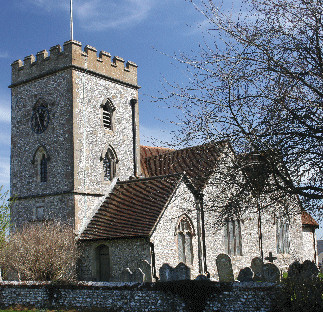
The image shows the Church of St. Andrew at Owslebury where William was baptised and married, as was his father before him. His grandfather
Edward Boyes had also been baptised there in 1748.
Owslebury is a village in central southern England about four miles south east of the ancient city of Winchester. Several generations of William’s ancestors had lived there as yeoman farmers, tenants of the Marwell estate, where their primary source of income was wool from the sheep which grazed on the downs.
In 1830 there was public disorder in Owslebury. It was one of the so-called ‘Swing Riots’ which were prompted by the recession that followed the Napoleonic Wars and the introduction of labour-saving machinery such as threshing machines, both of which caused job losses. William’s father John’s attempt to intervene resulted in him being accused of extortion for which he was tried and transported to Van Diemen’s Land. He did not serve his full seven year sentence because, after receiving support from several prominent politicians, he was pardoned and returned home after three years. While he was away there were fears that the family might lose the tenancy of their farm and become homeless but that did not happen probably due to the kindness of the Lady of the Manor, Lady Mildmay.
In August 1828 William married a local girl called Cecilia Wadmore in Owslebury. They lived in Hensting, near to his father
and next door to the village shop. He worked as an agricultural labourer, probably on his father’s farm. William and Cecilia had two sons
(Reginald and William) and three daughters (Angelina, Emma and Ellen). But on the 16th of November 1843, Cecilia died of asthma. Her
youngest child, Ellen, was only five years old.
Ten months after Cecilia died William married again. His new wife was Harriet Noble, a widow who was living at a nearby pub, the Anchor Inn in Bishopstoke, with her widowed mother Mary Slade. Harriet’s brother John Slade and William’s mother Faith witnessed the ceremony. By then William had taken up a new trade — he had become a timber carrier — he had probably been introduced to that business by James Vear who was a good friend of his father. William and Harriet lived at Crowd Hill, a mile or two from Hensting. They had seven children — John, Edward, Harriet, George, Alfred, Richard and Enos.
William’s unmarried sister, Anna, lived next door to him with her son George and her niece Eleanor who was the daughter of her deceased sister Eleanor. William lived a quiet life with his family. His farm at Crowd Hill was about half a mile south of Fishers Pond.
In March 1866 William was jailed for 21 days, with hard labour; the case was reported as follows in the Hampshire Telegraph:
“William Boyes, farmer, of Owslebury, was charged by Susan Frewin with indecently exposing himself on the high
road at Fisher’s pond, on the 14th of February. Mr. Wallis, of Portsmouth, appeared for the complainant, and Mr. Leigh, of Southampton, for
the defendant. The prisoner was sent to gaol for 21 days, with hard labour.”
In 1870 William Boyes was a witness in a perjury case against a police constable. A dispute between William and Peter Phillips had been heard before the City Bench. It arose from an incident in 1866 concerning a sledge-hammer and the case revolved around the identification of the hammer. Edward Light was an employee of Boyes’ who lodged with his aunt Mrs. Phillips, the wife of Peter Phillips. Boyes had previously lent a large sledge-hammer to Phillips and later Mrs. Phillips asked Edward to bring the hammer to her again. Edward did so, but without Boyes’ permission. Later, when Edward left Boyes’ employment, he asked his aunt for the hammer so that he could return it, but she refused. Boyes’ son Edward later found the hammer in one of Phillips’ fields, near a chalk pit, and took it home. Boyes informed Police Constable Turrell, of Fair Oak, and, in February 1868, Phillips was brought before the magistrate charged with having the hammer improperly in his possession, but the case was not proven. Fifteen months later, in May 1869, Phillips commenced an action for malicious prosecution against Boyes, which was not successful, but during the course of that trial it became apparent that Constable Turrell, who was a friend of Phillips, had perjured himself. John Boyes’ sons John and Edward appeared as witnesses in the perjury hearing. The magistrate, Mr. Budden, committed Constable Turrell for trial at the assizes with £40 bail and £20 security each from two guarantors, one of whom was his superior, Police Superintendent Everitt.
In 1871 William sold a house and some land to his brother-in-law, Jonathan Frogwood, the husband of his wife’s deceased sister Elizabeth. Jonathan was a miller and inn-keeper in the St. Cross district of Winchester. He paid £1200 for it. Jonathan later moved to Millbrook so the property had probably been passed down to William’s wife Harriet from her grandfather James Slade.
The Hampshire Advertiser reported that, in September 1874, an attempt was made to steal William and Harriet’s tame rabbit:
“Charles Sharp was charged with having, on Monday, stolen
a tame rabbit, at Bishopstoke, the property of William Boyes, of Fair Oak, upon whose premises the prisoner was seen, by Jane Wray,
looking into the rabbit hutches. Mrs. Boyes missed a rabbit, and Police constable Young being called in found the animal in the prisoner’s
possession, and Boyes identified it as belonging to him.”
William’s eldest son, who was also called William, died in 1875 after a long illness.
William began to have money problems. His sons, John and Edward, speaking later in a court case, said that one of their brothers had “squandered a lot of money which their father once had”. They did not name that brother.
In 1881, and again in 1882, William appeared in court for failing to pay his Poor Rate. The sums were £6 and £3 7s 6d respectively. On the first occasion the court sent in bailiffs. (The Poor Rate was a tax on property which was used to help support the poor of the parish. It eventually evolved into the Rates, the Poll Tax, and finally the Council Tax that we have today.)
By 1884 William had been admitted to the Union Workhouse in Winchester and in May of that year two of his sons, Alfred and Edward, were ordered by magistrates to help pay for his support. The local newspaper, remembering the hammer case, reported the event as follow:
“THE CELEBRATED CROWD-HILL HAMMER. — Edward and Alfred Boyes were summoned by Mr. Cull, relieving officer
of Twyford and Bishopstoke, to compel them to contribute to the support of their father, now an inmate of the Union, but who some years ago was famous
as a litigant in connection with the Fair Oak hammer, which consumed in law expenses its exact weight in gold. The ancient villager is now in the
Union, and the sons were called on to aid in his maintenance, and, as they admitted their liability by their absence, the bench ordered them jointly
to pay 3s weekly and 33s 10d costs.”
William died of old age in the Winchester Union Workhouse in Winchester on the 16th of April 1886. He was buried in Colden Common on the 22nd.
A year later the Hampshire Advertiser reported that two of his sons, John and Edward, were ordered to help pay for the support of their mother, Harriet, who was in the care of the South Stoneham Union Workhouse at Hedge End near Southampton.
“THE SUPPORT OF A MOTHER. — John Boyes and Edward Boyes, one described as a farmer and the other an innkeeper, at
Winchester, were summoned at the instance of South Stoneham Guardians, with regard to the maintenance of their mother, who had become chargeable to
the Union. — The defendants said there were six brothers, one of whom lived at home, and they alleged that he had squandered a lot of money which their
father once had. They were willing to pay equal shares with the other four sons. — The bench made an order for each defendant to contribute 2s per week
towards their mother's support.”
Their brother whom they claimed had squandered their father’s money was probably Alfred.
When William’s wife Harriet died in May 1893 she was still living in the workhouse.
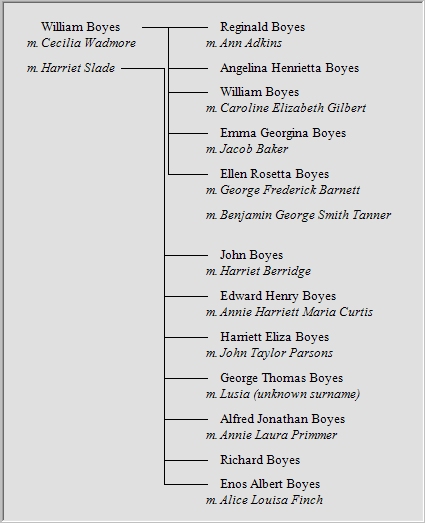
Children of William Boyes with Cecilia Wadmore and Harriet Slade
William had five children with Cecilia and seven with Harriet. Harriet had one child, a boy called Thomas Noble, with her previous husband.
• Reginald was William’s first child and he was baptised in Owslebury on the 29th of
March 1829. He became a labourer on the railways and in October 1850 he married a girl called
Ann Adkins in Cropredy in Oxfordshire. The couple lived there for three years, near to her parents, and then travelled to Australia on the assisted
passage scheme arriving in New South Wales in December 1853. They both lived to a good age and they had at least one child.
• Angelina Henrietta was William’s first daughter. She was baptised in Owslebury on the 20th of October 1831. Her mother died when she was about twelve years old. Henrietta (as she was known) found work as a kitchen maid and when she was twenty years old she was living in the household of Mr. Thomas Shute, in Bramshaw in the New Forest. She never married and she died late in the summer of the year 1857.
• William was baptised in Owslebury on the 23rd of March 1834. His mother died when he was about nine years old and about a year later his father re-married. Young William lived with his father and his step-mother. He worked as a general labourer. In 1860 he married Caroline Elizabeth Gilbert, a Southampton girl. The couple lived in Bishopstoke, not very far from Crowd Hill where his father lived. They had four daughters — Susannah Caroline, Rosa, Elizabeth and Cecilia, and one son whom they named William.
William became a member of the Ancient Order of Foresters and, in 1875, when he was only forty two years old, he died after a long illness. The funeral was reported in the local newspaper:
“
FAIR OAK, MARCH 20. Funeral of a Member of the Ancient Order of Foresters. — A Forester’s funeral took place at the above parish church,
on Tuesday, when Br.William Boyes was borne to his last resting place by four of the bretheren of the order. Br.Boyes had been a great sufferer
for the last twelve months. He leaves a widow and five children to mourn his death. He was only 42 years of age. Br.W. Hebbes, P.C.R,
attended the funeral to represent Court 4988, of which Br. Boyes was a member for upwards of seven years.”
• Emma Georgina was baptised in Owslebury on the 16th of October 1836. She was seven years old when her mother died and just under a year later her father married again. By the time she was 16 years old she had left home to go into service in a private home in Southampton. On the 11th of May 1856 she married a seaman called Jacob Baker. Jacob had been born on the Isle of Wight but the marriage was in Southampton. They lived in the centre of Southampton in French Street where they had two children, a daughter whom they named Emma Georgina after her mother and a son called William. But in May 1862 Emma (the mother) died. The two children then went to live with friends of relatives of Jacob’s family on the Isle of Wight.
• Ellen Rosetta was born on the 30th of August 1838 in Owslebury. Her mother died when she was just five years old and she grew up with her father and step-mother. In 1863, when she was twenty four years old, Ellen married a maritime engineer called George Frederick Barnett and went to live in Southampton. They had one child, a girl called Lillian, but in 1867 George died at sea. Ellen continued to live in Southampton and in 1872 she was a witness at the wedding of her half sister Harriet to the Southampton publican John Parsons. Ellen married again in 1873. Her second husband was Benjamin George Smith Tanner, a baker and confectioner who orginally came from Dorset but was living in Putney in London. They had several children. Ellen died in July 1900 and was buried at St Mary’s in Putney.
• John was was William’s first child with his second wife, Harriet Slade. He was born in Bishopstoke in about 1846. John became a timber carrier, the same trade that his father had followed as a young man. In 1866, when he was about twenty, John married Harriet Berridge, a girl who had been born and brought up in the county of Rutland. They settled in Fair Oak, not far from where John had been born, and lived there for the rest of their lives. John soon became a farmer and timber dealer and the family lived for many years at Stubbington Farm near the centre of the village. John and Harriet had four children — Harriet, Levinia, Reginald and Ann. In 1887 John, together with his brother Edward, was ordered by magistrates to pay 2s each a week towards the upkeep of their mother.
• Edward was born in about 1848 and grew up with his parents in Fair Oak. As a young man he seemed to have been a rather wild character and made frequent appearances at the magistrates’ bench. When he was seventeen years old he was fined £3 for driving a timber cart dangerously. (He had left the horses unattended and they caused another cart to be overturned.) In 1871 he and a friend were brought before the court for wilfully damaging a farmer’s gate; the case was dropped when the defendants apologised and paid for the repair. He married at the age of twenty two but just afterwards he was ordered by the court to support the illegitimate child of Elizabeth Steele of which he was the father.
Edward’s wife was Annie Harriett Maria Curtis, a Winchester girl. After marrying he might have been expected to settle down, but a few years later he was brought before the magistrates again. He had been involved in a fight near Fishers Pond with William Morgan, a Royal Navy veteran of 20 years, for which he was fined £1. And in 1880 he was sued for non-payment of a debt. He had given a signed I.O.U. but later denied the signature was his; the magistrates disagreed and ordered him to pay the £10 saying that he was lucky not to have been prosecuted for perjury.
Edward became a publican. He lived in Fareham, about 15 miles from Fair Oak, for a while. He was the landlord of the Castle In The Air, a pub which still exists, but the magistrates refused to grant him a permanent licence saying “the applicant was not a person likely to raise the character of houses kept by licensed victuallers, who, as a body (they said), were respectable men”. Edward lived in Winchester for most of his married life. In 1879 he was landlord of the White Horse Inn in Canon Street and in 1891 he was at the New Inn in Staple Gardens.
Edward and Annie had five children: Alfred, Lillian, William, Violet and Daisy.
In 1887 Edward, together with his brother John, was ordered by magistrates to pay 2s each a week towards the upkeep of their mother.
Early in 1893 Edward died. A few years later his wife, Annie, married again. Her new husband was George Beazley, a boarding house keeper in Winchester.
• Harriett Eliza. Born in Fair Oak in 1852, Harriet Eliza Boyes married the Southampton publican John Parsons when she was twenty years old and he was twenty five. She lived with him in a succession of Southampton pubs until she died of bronchitis in 1921. They had just two children: Sidney Alfred Parsons and William Leonard Parsons.
Harriett was a great-grandmother of the author of this web page and details of her life can be read at Harriet Eliza Boyes’ biography.
• George Thomas was born in about 1855. He married a girl called Lusia, Lucy, or Luoise who had been born in Henley-on-Thames, in Oxfordshire. They lived in Eastleigh in Hampshire, a new town which grew up as a railway centre near Fair Oak during the 19th century. George and his wife probably emigrated to Australia.
• Alfred Jonathan. Alfred was born in Fair Oak in about 1857 and lived at Crowd Hill with his parents until he was in his mid 20s. In 1884 he married Annie Laura Primmer, a domestic servant, in Reigate in Surrey and they lived in that area for the rest of their lives. Alfred worked as a general labourer and cowman. In 1884 he and his brother Edward were ordered by magistrates to assist in the maintenance of their father who was living in a workhouse in Hampshire. Alfred and Annie had seven daughters and five sons. He died in May 1924 and was buried in Reigate.
• Richard was born in about 1861. He was recorded in the 1861 census as a baby living with his parents, but after then he disappeared from the records. He may have died while he was still an infant.
• Enos Albert was also born in about 1861. He grew up living with his parents in Fair Oak and Colden Common. In 1843 he married Alice Louisa Finch. They lived in Winchester where Enos worked as a baker. The couple had seven children: Enos Edward, Sydney Walter, Eliza Marion, Joseph W, Arthur J P, Ivy May, George, and Violet. Enos continued as a baker for most of his working life but by 1911 he had become a carter. He died in 1941.
Ancestors of William Boyes
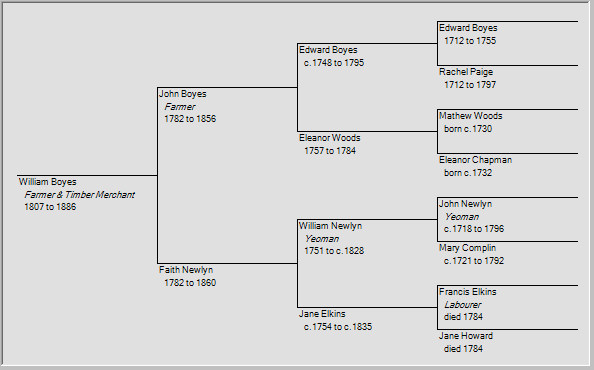
Parents
Father — John Boyes
Mother — Faith Newlyn
Grandparents
Grandfather — Edward Boyes
Grandmother — Eleanor Woods
Grandfather — William Newlyn
Grandmother — Jane Elkins
Great-grandparents
Great-grandfather — Edward Boyes
Great-grandmother — Rachel Paige
Great-grandfather — Mathew Woods
Great-grandmother — Eleanor Chapman
Great-grandfather — John Newlyn
Great-grandmother — Mary Complyn
Great-grandfather — Francis Elkins
Great-grandmother — Jane Howard
Return to Sidney Parsons’ Ancestors
You are free to make use of the information in these web pages in any way that you wish but please be aware that the author, Mike Parsons, is unable to accept respsonsibility for any errors or omissions.
Mike can be contacted at parsonspublic@gmail.com
The information in these web pages comes from a number of sources including: Hampshire County Records Office, Somerset Heritage Centre; Dorset County Records Office; Southampton City Archives; the General Register Office; several on-line newspaper archives; several on-line transcriptions of Parish Register Entries; and several on-line indexes of births, marriages and deaths. The research has also been guided at times by the published work of others, both on-line and in the form of printed books, and by information from personal correspondence with other researchers, for all of which thanks are given. However, all of the information in these web pages has been independently verified by the author from original sources, facimile copies, or, in the case of a few parish register entries, transcriptions published by on-line genealogy sites. The author is aware that some other researchers have in some cases drawn different conclusions and have published information which is at variance from that shown in these web pages.
Copyright © 2013 Mike Parsons. All rights reserved.