 Sidney Alfred Parsons and his Ancestors
The Complin Families of Morestead
The Complin family’s association with the village of Morestead began in the early 1680s when John Complin and his wife Faith settled there after they married and it continued until 1868 when Elizabeth, the widow of their great-great-grandson William Complin, was buried in the village.
The family’s link to the present author was through Mary Complin, who lived from 1721 to 1792 and married John Newlyn. John Newlyn was an ancestor of Sidney Alfred Parsons and Sidney was a grandfather of the present author. Mary was therefore the most recent person born with the surname Complin to be an ancestor of Sidney Parsons. Her granddaughter Faith Newlyn was the wife of John Boyes of Owslebury who became well known for his role in the 1830 Swing Riots. And John Boyes was a great-grandfather of Sidney Alfred Parsons. Mary Complin was therefore a three-times great-grandmother of Sidney’s and was the link between the Complins and the rest of the extended Parsons family.
By the time Mary Complin was born members of the Complin family had been living in the vicinity of the city of Winchester in the County of Hampshire for at least 300 years. Court papers for 1415 refer to a William Complyn of Wyke being assaulted with a bow and arrow. Wyke (or Weeke) was a small village just outside the north-western edge of the city. Detailed records of the family began on the 21st of May 1498 when Mary’s ancestor William Complyn (who was probably a grandson of the William who was assulted) died in Weeke. A few years later a brass plate was placed in the church there with an inscription commemorating him and his wife Agnes who had been generous benefactors when it was rebuilt. A copy of the inscription and the engraving of St. Christopher which is above it can be found by following this link — The Complyns of Weeke.
The map below dates from the late 1870s. Most of the villages mentioned in the text are underlined in red.
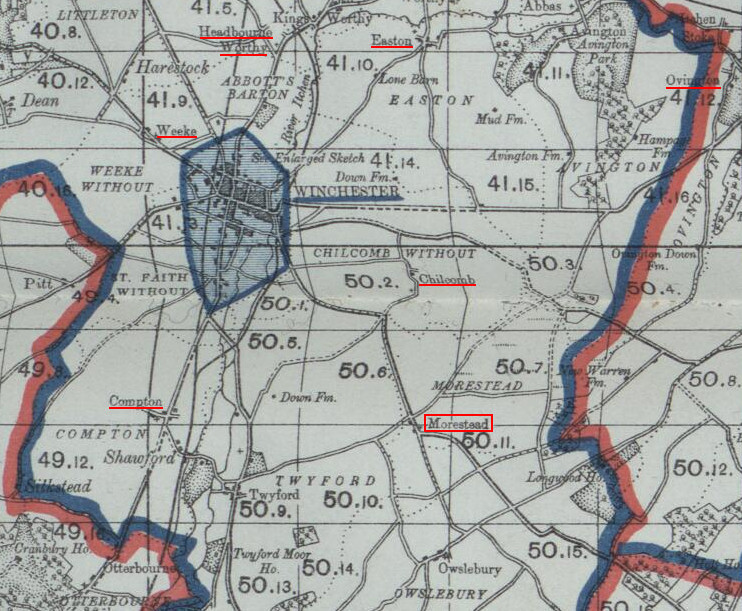
Weeke, where the earliest known Complins were living in the 15th century, is just outside the north-western boundary of the city of Winchester.
Headbourne Worthy is north of Winchester. Mary’s grandparents John Complin and Faith West had married there in 1680 and John’s grandfather, who was also called John Complin, had owned a cottage there in the early 17th century.
Easton was Mary’s home when she married John Newlyn. After her father died in 1744 she lived there in a cottage called The Water House which was owned by her brother John who had probably inherited it.
Chilcomb was the home of Mary’s great-nephew William Complin who lived from 1799 to 1832.
Compton was the home village of Mary’s mother’s family, the Goldfinches who were known to be living there during the Civil War in the middle of the 17th century and continued to be prominent members of the village community until the 1830s.
North Baddesley, where Mary’s parents spent the early years of their married life, is off the map, below its bottom left corner. It is about ten miles south-west of Winchester.
Wonston is about seven miles north of Winchester and above the top of the map. Mary’s sister Anne spent her married life there as did her niece Hannah. Her nephew Charles Complin, who never married, also lived there until his death in 1826.
Ovington (near the top right of the map), where Mary’s nephew William Complin (1753 to 1825) lived until he married.
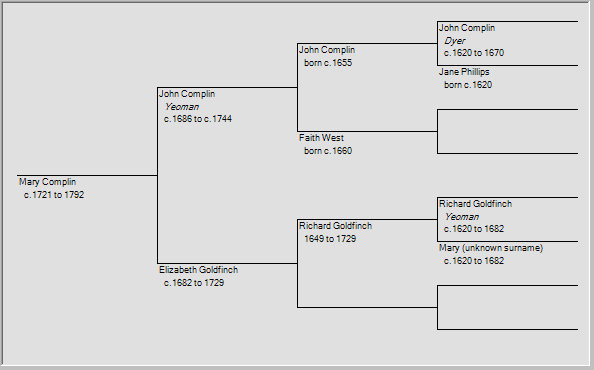
The chart on the right shows three generations of Mary Complin’s ancestors. For information
about earlier generations of Complins please click on the following link —
The Complyns of Weeke & Headbourne Worthy.
Mary Complin’s grandfather, John Complin, was born some time during the 1650s. His father, who was also called John Complin, was a dyer who worked in Winchester and Mary’s grandfather was probably born there. His grandfather, who was also called John Complin, had lived in or near Headbourne Worthy, a scattered village about two miles north of Winchester, where he leased land. The Complins of Headbourne Worthy were descended from the Complyns of Weeke.
Mary’s grandfather John married Faith West in the church at Headbourne Worthy on the 9th of September 1680. They were married by licence and from the entry in the parish register it seems likely that neither the bride nor the groom were living there at the time but actually came from Compton, a village south of Winchester. Strictly speaking, that should not have been allowed, but payment of a licence fee could sometimes smooth over such bureaucratic difficulties, and the entry of their marriage in the parish register seems deliberately ambiguous which supports that contention.
John and Faith settled in Morestead where John leased a farm from the Bishop of Winchester. They lived there for the rest of their lives and began the family’s long association with the village.
John and Faith Complin’s son John (Mary’s father) was born in
Morestead early in the year 1686 and he was baptised there on the first of April. More
details of his life can be found at — John Complin of Morestead (1686 to 1744). The first three
generations of the Complin family in Morestead are shown in the following chart:
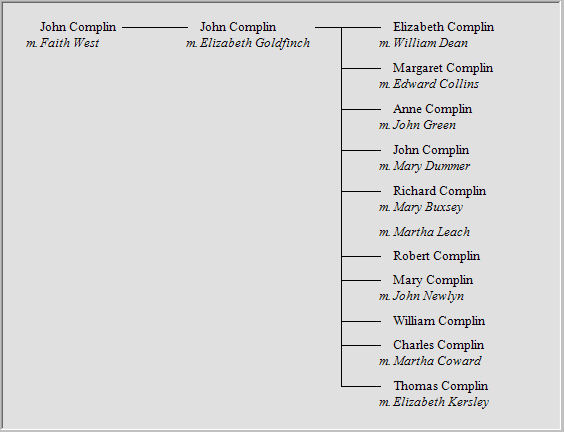
Mary’s father John was born in Morestead in 1686
and married Elizabeth Goldfinch
on the 29th of November 1709 in Compton, her home village, which is a couple of miles south of Winchester. He was farming in
the village of Baddesley at the time, about ten miles south-west of Winchester and their first four children were born
there. But in about 1717, when their son Richard was born, they moved back to Morestead. Perhaps John’s father had died or become infirm
and decided to hand the family farm over to his eldest son. We can not be sure because the burial records have not survived.
Mary was baptised in Morestead on the 8th of February 1722 and her mother Elizabeth died six and a half years later in 1729 leaving John to bring up their young family.
John died in 1744 leaving a will in which he entrusted his younger children (including Mary) to the care of Charles Wade and John Goldfinch of Compton who was a relative of his wife Elizabeth. But his eldest son John was already a family man having married Mary Dummer two years earlier and it was he who inherited the family farm in Morestead.
Morestead was and still is a small village. The Victoria County History published in 1908 describes it as follows:
The small parish of Morestead, covering an area of 1,701 acres, is on high ground south-east of Winchester, the Roman road
from Bishop's Waltham to Winchester forming the northern part of its western boundary. The village lies on comparatively low ground in the south-west of
the parish at the junction of the Roman road to Winchester, which forms the main village street, with a narrow lane running across the fields from
Twyford, which here crosses the main road and continues a north-westerly course, as Fawley Lane, over Fawley Down to meet the main road from
Petersfield to Winchester, just outside the boundaries of Morestead parish. The few cottages that comprise the village, with Complin's Farm,
Burgers' Farm, and the church and rectory, lie south of the junction, the church, near which is a reputed Roman well, lying to the east of the main
road. South-east of the church is the rectory surrounded by a beautiful old-world garden. On either side the land rises from the village, Morestead
Down sweeping away north-east of the Roman road, which cuts its way north between the down and a thick belt of hedgerow. Again to the south-west is
Hazely Down, while north and east are Fawley Down and Longwood Warren, where there is a rabbit warren of some local fame. Patches of woodland, St.
John's Copse, Grove Copse, and Old Down Copse, mingle with the open country to the south between the village and Old Down Farm, which lies in the
furthest south-west corner of the parish. Immediately south of the village, on a branch road leading to Owslebury, is Morestead Farm, south again of
which is Morestead House, the property of Mr. R. Eden Richardson, whose large game farm supplies many of the neighbouring estates with birds. To the
south-west is a fine house 'The Firs,' the residence of Mr. Joseph Storey Curtis, who owns a large training stable and to whom the lately-inclosed
'No Man's Land,' consisting of about five acres in the extreme south of the parish, belongs.
The soil being loam on chalk is very poor, and although there are 515 acres of arable land as compared with 340 of permanent grass and 35 of
woodland, much of the arable land is now being rapidly converted into pasture. A considerable number of sheep are reared on the downs, and these
with the game farm and racing stable furnish occupation for the inhabitants.
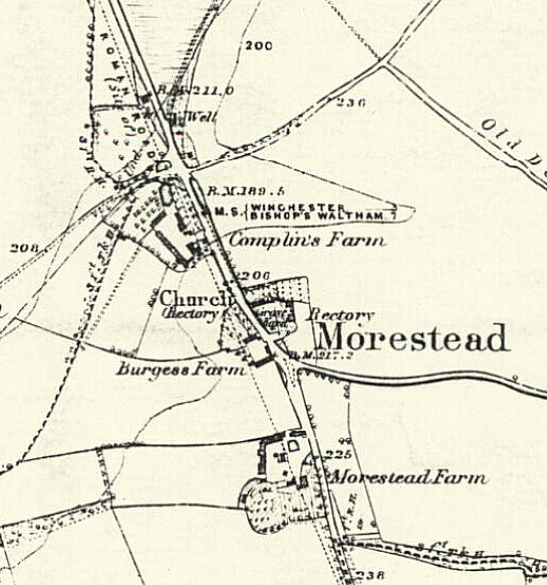
As can be seen from the old map on the right the Complin family’s farm was situated near the centre of the village just north of the church.
Children of John Complin and Elizabeth Goldfinch
Mary’s parents John and Elizabeth had ten children. They were:
• Elizabeth was John and Elizabeth’s first child. She was born while they were living in North Baddesley and she was baptised there on the 30th of November 1710. Elizabeth was eighteen when her mother died and she continued to live in Morestead until four years later when she married. Her husband, William Dean, was a farmer from Bishopstoke (which is not far from North Baddesley) and the ceremony was held there on the 26th of May 1733. William and Elizabeth spent the rest of their lives in Bishopstoke. He died there in 1766; she died ten years later and was buried on the 14th of February 1776.
• Margaret was baptised in January 1712, also in North Baddesley. She stayed in Morestead until 1738 when, aged 26, she married Edward Collins, who was a joiner, at St. Peter’s Cheesehill in Winchester on the 3rd of August 1738. This was in an early eastern suburb of the city which was known as the Soke or Soake. Their wherebouts after then are not known.
• Anne was baptised in December 1713. She married John Green, a farmer from Wonston which is about seven miles north of Winchester, and settled there with him. They had a son called John but other than that nothing more is known about their lives.
• John was John and Elizabeth’s first son and the last of their children to be born in North Baddesley. The family moved to Morestead soon after he was born. He inherited the family’s farm in Morestead and lived there until he died in 1779. Read more about him below.
• Richard was baptised in Owslebury, a parish which adjoins Morestead, on the 30th of December 1717. In 1747 he married Mary Buxsey in Morestead and they had three children, all daughters, whom they named Mary, Ann, and Sarah, but Sarah died soon after she was born. Four and a half years after they had married, on the 9th of June 1752, Richard’s wife Mary died. She was buried in Morestead. Eight years later Richard got married again. His second wife’s name was Martha Leach. Richard and Martha had one child together, a daughter called Martha who died in 1768 when she was about six years old. Richard’s wife Martha died in 1801 and Richard died in 1806. He was buried in Morestead on the 6th of July.
• Robert was baptised in Morestead on the 10th of March 1720. He died when he was just over two years old.
• Mary was baptised in Morestead on the 8th of February 1722. She was not yet seven years old when her mother died. Her father died in 1744 and a year later, when she married John Newlyn, she was living in Easton, a small village north-east of Winchester, where her family owned a house and land. Mary and John lived in Easton for a few years before moving to Compton, a village which is is just south of Winchester, where they remained for the rest of their lives. They continued the line of descent to the present author via John Boyes of Owslebury and Sidney Alfred Parsons and their stories can be read at their own pages — Mary Complin’s Story and John Newlyn’s Story. Mary died in 1792.
• William was baptised in Morestead on the 30th of March 1724. Nothing is known of him until April 1781 when he was buried in Morestead.
• Charles, who was baptised on the 15th of February 1726, became a became a butcher and owned a slaughter house and stables in Winchester. They were in Water Lane, by the River Itchen, in the East Soke district. He also owned a house and a farm in Kings Worthy which is a village just to the north of Winchester. In 1779, when his brother John died, Charles was the main executor of his estate. In 1753 Charles married Martha Coward in Chilcomb, which is about a mile and a half east of Winchester. It is known that they had children and grandchildren but the names of their children have not yet been discovered. When Charles died in September 1808 he was buried in Morestead. After his death his widow Martha lived in Morestead and she died their in 1816.
• Thomas, John and Elizabeth’s youngest child, was baptised in Morestead on the 17th of September 1728. He grew up and farmed there and on the 16th of November 1758 he married Elizabeth Kersley. Elizabeth was the daughter of John and Sarah Kersley born in about 1737 in Bishops Sutton, a village about eight miles east of Winchester near the town of New Alresford. Thomas and Elizabeth settled in Twyford which is a village near Morestead and it appears that they had no children. Thomas died in Twyford in March 1767 and was buried in Morestead. His wife Elizabeth did not re-marry and and when she died in 1809 she was also buried in Morestead.
John Complin (1715 to 1779)
John was the eldest son of John Complin and his wife Elizabeth Goldfinch and he was the last of their children to be born in North Baddesley. He was baptised there on the 29th of December 1715. John grew up in Morestead and when he was 25 years old he married a girl called Mary Dummer who was living in Winchester but had originally come from Bishopstoke. The wedding was held in Winchester in the parish church of St.Thomas on the 17th of November 1742 and they were married by licence rather than by posting banns.
John and Mary lived in Morestead but he also leased land and a house in Easton, a few miles north-east of Winchester, which he retained
until the end of his life. The house was described as:
“a little dwelling house called the Water House in Easton, and one Peak of ground, containing 100 luggs”
In addition to the house there were 11 acres of land in Easton. This was the house in which John’s
sister Mary was living in 1745 when she married John Newlyn.
John and Mary had ten children three of whom died as infants or young children.
John died aged 63 in February 1779 and was buried in Morestead on the 17th of that month. His wife Mary lived for another twenty nine years. When she died in 1808 she was 87 years old and she was also buried in Morestead.
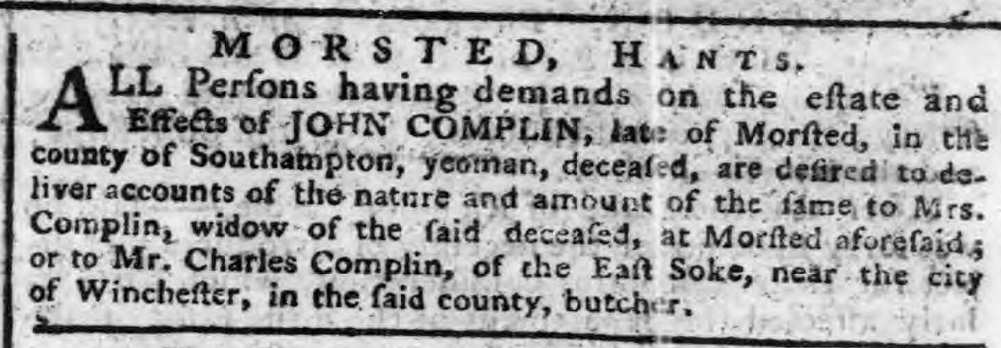
John’s brother Charles, who lived in Winchester, dealt with his affairs after he died. The notice on the right was
published in the Hampshire Chronicle on the 5th of April 1779.
John’s eldest son John, who was unmarried and 33 years old when his father died, inherited the farm in Morestead. He already had his own farm a few miles away in Holt but he let it out and and went back to Morestead to live with his mother.
Children of John Complin and Mary Dummer
John and Mary had ten children, seven girls and three boys, but two of their daughters died while they were still babies and another when she was only seven years old. Their son John inherited the farm but he never married and when he died it passed to his nephew John who was the son of his brother William.
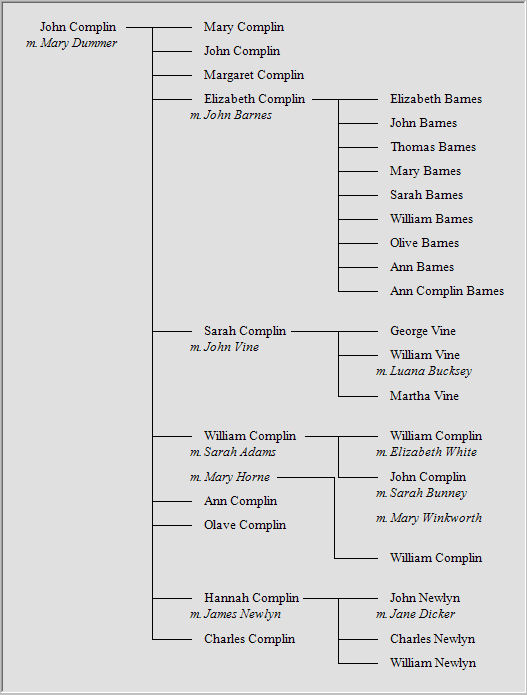
• Mary was John and Mary’s first child. She was baptised in Morestead on the
15th of November 1744. Mary died in June 1752 when she was only seven years old.
• John was born in Morestead in December 1745 or early January 1746. As a young man he had a farm in Holt, in the parishes
about four miles south-east of Morestead in the parishes of Upham and Kilmeston. It was a large farm by the standards of the time with 300 acres
of arable land and grazing rights for sheep on Stephen’s Castle Down. It was close to Mill Barrow Down where the well known pub called
Milburys now stands. When his father died John inherited the family farm in Morestead and went to live there with his mother letting out his farm in
Holt. John lived a respectable life in Morestead and became an Overseer of the Poor for the parish but he never married. He eventually
disposed of his farm in Holt and bought the blacksmith’s shop in Morestead which he rented out. His mother died in 1808.
When John’s uncle John Newlyn of Compton wrote his will in 1792 he appointed his nephew John as one of the executors.
In 1798 John bought the lease of a piece of land called Pudman Bottom in an area called No Mans Land which was an extra-parochial area associated with Morestead. It formed a part of Longwood Warren and there was a pub there called the Fox and Hounds. John paid £52 10s for the lease which was for the term of three lives.
When John died in December 1813 he was, according to the inscription on his grave stone, in the 69th year of his age. Having no children of his own he left the majority of his estate to his 13 year old nephew John who was the son of his brother William, to be released to him when he reached 26 years of age.
• Margaret was baptised in Morestead on the 17th of March 1748 and buried on the 2nd of June.
• Elizabeth was baptised on the 20th of June 1749 and grew up in Morestead. When she was 21 years old she
married John Barnes jnr. who was a yeoman farmer from Nether Wallop in Hampshire. Nether Wallop is about eighteen miles to the north-west of
Morestead and lies between Andover in Hampshire and Salibury in Wiltshire. The couple were married by licence in Nether Wallop on the 2nd
of June 1770 and they settled down there and raised their family of nine children. In 1814 Elizabeth inherited £50 (a considerable sum in those
days) from her brother John.
• Sarah, John and Mary’s fourth child, was baptised in May 1751. In 1776, when she was 25 years old, she married
John Vine in Morestead. John was a yeoman farmer from North Stoneham which is just north of Southampton on the road to Winchester but they
settled in the village of Otterbourne which is closer to Winchester and about six miles west of Morestead. John and Sarah had at least three children
before she died aged only forty one years old. The following message was inscribed on her
grave stone — “In Life and in hope of Divine Redemption. To the memory of SARAH the Wife of JOHN VINE who departed this life
7 July 1792 Aged 41”.
By a curious coincidence there is a link between the family tree of Sidney Parsons, who was a grandfather of the present author, and that of Sidney’s wife Dorothy Bennett. John and Sarah Vine’s son William had a daughter by his wife Luana Bucksey whom they named Ann Luana Vine. When she married she became the third wife of Charles Light who was an ancestor of Sidney Parsons’ wife Dorothy Bennett (Dorothy was a great-grandaughter of Charles’s by his first wife).
Sarah and John’s son William Vine was for many years the owner and landlord of The Hut Inn in Chandlers ford, and when he died it was passed to his son Thomas Vine who kept it until the 1880s.
• William was baptised in June 1753 and buried there in February 1825. His daughter-in-law Elizabeth was the
last person bearing the name Complin to be buried in Morestead. Read more about him below, or by following this link —
William Complyn and the Last Complins of Morestead.
• Ann was baptised on the 10th of June 1755. She never married and died in Morestead when she was only
32 years old.
• Olave was baptised on the 22nd of June 1757 and died about a week later. In the register of burials
there is a note that she was also known as Olive.
• Hannah was John and Mary’s youngest daughter. She was baptised in August 1758. When her father died in 1779
she was 21 years old. Hannah remained single for another 15 years and then she married her cousin James Newlin who was the son of her Aunt Mary.
James was 28 years old, about eight years younger than her. The wedding ceremony was held in Morestead on the 23rd of June 1795.
Hannah and James went to live in Wonston where John leased a farm. (Wonston is about 7 miles north of Winchester and Hannah’s Aunt Ann lived
there with her husband John Green.) James and Hannah had three sons
— John, Charles and William — who were born in 1796, 1799 and 1802 respectively. After her husband died in September 1810 Hannah continued
to live in Wonston and in June 1841 she was still there living with her son Charles. She died at the end of March 1842 and her body was taken to
Morestead where she was buried on the 1st of April.
• Charles was John and Mary’s youngest child. He was baptised in Morestead on the 11th of April 1762 and
he was about 16 years old when his father died. He grew up to become a businessman and land-owner with property in Winchester, Twyford and Wonston where
he lived. Charles never married but he had a close relationship with his house-keeper Letitia Barns and when he died in December 1826 he left the interest
and produce from his estate to her and her daughter Elizabeth. He also made bequests to his nephews and nieces.
William Complyn and the Last Complins of Morestead
William Complyn, who lived from 1753 to 1825, was born in Morestead and died there too, but his son John was the last of the Complins of Morestead.
John Complin and Mary Dummer had ten children but only three of them were sons. Their eldest son John, who inherited the farm in Morestead, never married and had no children. Neither did their youngest son Charles. So it was left to their other son William to continue the family name. William, who lived from 1753 to 1825, spent his whole life in Morestead.
William Complin was 25 years old when his father died. Just over two years later he had an illegitimate son with a girl called Mary Horne but the child died at birth. The baptism and burial entries in the Morestead parish register are unusual; they read:
On April the 22nd 1781 — “William Cawtard Complin son of William Complin & Mary born Bastard and baptised by the Man-Midwife, buried 23rd”
And on the following day — “William bastard son of William Complin & Mary Horne born and baptised the day before by the Man-Midwife so I was told”.
William became a maltster, but nothing more is known of his life until nearly eighteen years later when, at the age of 45, he got married. His bride was called Sarah Adams and she lived in Gosport. The wedding was held there at Holy Trinity church and Sarah was six months pregnant at the time. Gosport is a town with strong maritime connections on the shore of Portsmouth Harbour. It had experienced significant growth during the previous fifty years, especially since the French Revolution and the rise of Napoleon. The surving records offer no clues as to why William was so far from his home village but it may be that he was selling his malt there to produce beer for the Royal Navy and workers at the Royal Dockyard in Portsmouth for which the main victualling depot was the Royal Clarence Yard in Gosport.
Sarah left Gosport and went to live with William in Ovington which is a small village about five miles north-east of Morestead. Three months later the first of their two children was baptised there. The date was the 7th of April 1799. The child was a boy and they named him William. Two years later Sarah and William had another child, also a boy, and they named him John. But by then Sarah and William had moved to the Warren House which was below Longwood Warren, near to Morestead where William had been born, but within the boundaries of the neighbouring parish of Tichborne. They baptised their son John twice. First on the 30th June of 1801 in Tichborne and then again on the 7th of July in Ovington.
In 1810, when William’s brother-in-law James Newlyn died, William was appointed as the executor.
William died on the 28th of February 1825 and was buried in Morestead. Sarah died died almost six years later on Christmas Eve 1830 and she too was buried in Morestead.
Children of William Complin and Sarah Adams
• William was William and Sarah’s first child. He was baptised in Ovington on the 7th of April
1799. His father died when he was 25 years old and two years later he married Elizabeth White in Chilcomb which is about three miles north
of Morestead. The wedding was on the on the 1st of October 1827. Elizabeth was living in Chilcombe at the time but she had been born in
Sparsholt on the western side of Winchester. After their marriage William and Elizabeth settled in Chilcomb.
William and Elizabeth’s first child was a son called John. He was born just two months after they married. Their second child was also a boy and they called him William after his father. He was born in April 1830 but he died less than two years later and was buried in Morestead. Less than one year after that Elizabeth’s husband William died and was also buried in Morestead. The father and son were buried in the same grave; the inscription on their memorial stone read:
“In Memory of William Complin died 25 September 1832 aged 32 also William son of William and Elizabeth died 19 November 1831 aged 1 year and 8 months”
Elizabeth was only 26 years old when her husband died but she stayed in Chilcomb and brought up her 4 year old son John. She never re-married. Her son John died when he was only 19 years old and he, like his father and brother, was buried in Morestead. Elizabeth was left alone.
Elizabeth’s niece Sarah Davis, from North Waltham, came to stay with her in Chilcomb and they lived there together until Elizabeth died on the 29th of November 1868 when she too was buried in Morestead, the last of the Complins to be buried there.
• John was William and Elizabeth’s second and final child. His parents had recently moved to Tichborne and he was baptised there on the 30th of June 1801. But nearly three weeks later he was baptised for a second time in their previous parish church at Ovington.
John’s Uncle John occupied the family farm in Morestead. It had been traditional for the family estate to be passed to the owner’s eldest son John, but Uncle John had no wife or children and when he wrote his will he decided to leave it to his nephew John. Young John was only 13 years old when his Uncle died and the will stipulated that the property was to be held in trust for him until he reached the age of 26. The estate which he inherited included the farm and a blacksmith’s shop in Morestead.
In 1823, before he was 22 years old, John had an illegitimate daughter with Mary Winkworth. Although John never married Mary it appears that he acknowledged Anne as his daughter. He was named as the father in the parish register and she kept his surname as a second name but when he wrote his will neither she nor her mother received legacies.
John was involved in two legal cases. In the first, in 1824, one of his hedges was destroyed by William Elkins who was, as a result, imprisoned for one month. That may have been a boundary or an access dispute as was the second legal case which was brought eight years later by a Mr. Sturgess who rented a farm which had previously been rented by John. John claimed that part of the farm, which he wished to use as an access route, was part of his copyhold estate, and he harrowed the crop which Mr. Sturgess had planted there. The piece of land in question was called Burgess’s Close. John lost the case.
In 1828 there was a programme of enclosures on the Bishop of Winchester’s land which included Morestead. Farmers who leased land stood to benefit from this and were asked to make contributions to the costs in proportion to the amounts of land they held. There were four leaseholders in Morestead. John Complin was the smallest and the largest was Lord Northesk who lived at Longwood House. Three of them agreed to pay but John refused saying that he did not intend to renew the lease when it expired. That led to a stalemate lasting three years and the Bishop’s clerk wrote in the records that “Complin is a most obstinate Farmer and caused the delay of the three years by refusing to join in the surrender alleging he did not desire to renew ”. Eventually a compromise was reached. John paid only £18 9d of the £36 14s 4d expected from him while Lord Northesk paid £7 of it and the Bishop wrote off the remainder.
The land which John had inherited from his Uncle John included Pudman Bottom, a part of Longwood Warren south of Morestead village which was called No Mans Land. On it there was a public house called the Fox and Hounds which was a meeting place for foxhunts in that part of Hampshire. William Cobbett mentioned it in his Rural Rides. The pub is still a popular country inn but now it is known as Milburys.
In the later years of his life John lived at the Fox and Hounds with a woman called Sarah Chapman. Sarah had a son called Walter by her husband Richard who did not live with her — he was, she said, a “Clerk at the Temple in London”. In 1833 Sarah had a second child, a girl called Sally, and John might have been her father because when he wrote his will four years later he left almost his entire estate to her. Sarah’s husband might well have died before Sally was born because a man with his name had been buried in St Marylebone, Westminster, in December 1829.
John died in February 1837 and was buried in Morestead on the 14th of that month.
Sarah Chapman continued to run the pub and lived there with her son Walter and her daughter Sally until at least 1851. It is not known what became of them after then.
Return to Sidney Parsons’ Ancestors
You are free to make use of the information in these web pages in any way that you wish but please be aware that the author, Mike Parsons, is unable to accept respsonsibility for any errors or omissions.
Mike can be contacted at parsonspublic@gmail.com
The information in these web pages comes from a number of sources including: Hampshire County Records Office, Somerset Heritage Centre; Dorset County Records Office; Southampton City Archives; the General Register Office; several on-line newspaper archives; several on-line transcriptions of Parish Register Entries; and several on-line indexes of births, marriages and deaths. The research has also been guided at times by the published work of others, both on-line and in the form of printed books, and by information from personal correspondence with other researchers, for all of which thanks are given. However, all of the information in these web pages has been independently verified by the author from original sources, facimile copies, or, in the case of a few parish register entries, transcriptions published by on-line genealogy sites. The author is aware that some other researchers have in some cases drawn different conclusions and have published information which is at variance from that shown in these web pages.
Copyright © 2014 Mike Parsons. All rights reserved.