 Sidney Alfred Parsons and his Ancestors
The Children of John Boyes of Owslebury and his Wife Faith Newlyn
John Boyes, who lived from 1782 to 1856 in Owslebury in Hampshire, and his wife Faith (née Newlyn) were grandparents of Harriett Boyes who was Sidney Parsons’ mother. Harriet was a daughter of their son William Boyes who lived from 1807 to 1886.
Owslebury is a village in central southern England about four miles from the ancient city of Winchester. Today, the village is just within the boundaries of the South Downs National Park.

John was a yeoman farmer who leased his house and his land from the Marwell estate. He and Faith lived in Hensting, a hamlet within the parish of Owslebury. Hensting is close to the eastern end of the small lake known as Fisher’s Pond. John’s ancestors had lived in the parish for several centuries at least. Faith had been born in London but her parents moved to Owslebury while she was still a young girl. Her mother Jane had been born on Owslebury and her father William Newlyn had originally come from Compton which is just a few miles away. William Newlyn was, like John Boyes, a farmer.
The soil in the area is clay with underlying chalk and the traditional land-use was a mixture of arable farming and grazing for sheep.
John and Faith had married in Owslebury in 1803 when they were both 22 years old. He became a well known and successful farmer who organised and led the annual shearing of the sheep which at that time formed the mainstay of the village’s economy. According to a contemporary source he was also employed by the lady of the manor, Lady Mildmay, in a “confidential situation”.
In 1830 there was trouble in Owslebury. The long recession after the Napoleonic wars and the ideas of social change which had been stirred by the revolution in France had created discontent among the working classes. There were riots in several places in the southern counties of England which became known as the “Agricultural” or “Swing” riots. There was one in Owslebury on the 23rd of November 1830. John Boyes was an employer but he sympathised with the rioters demands and, in an attempt to calm them, he accompanied them and negotiated with other employers in an attempt to raise wages. The government were alarmed by the civil unrest and all of the rioters were tried in Winchester in January, and John was tried with them. His case was unusual and attracted much attention in the press. He was at first acquitted but then re-tried and sentenced to be transported to Van Diemen’s Land (Tasmania) for seven years. There was a good deal of public sympathy for his plight and in June 1834, after several petitions, the Home Secretary, Lord Melbourne, pardoned him and he returned home to his farm.
John spent the rest of his life as a respectable yeoman farmer in Hesting. By 1851 he was farming fifty acres and employed five men.
John Boyes died in Hensting on the 25th of March 1856 of old age (described as “natural decay” on the death certificate). His wife Faith died four and a half years later on Christmas day 1860. They were both buried in the church yard in Owslebury. Their son Edward was present at both of their deaths.
John Boyes and Faith Newlyn’s children

John and Faith had six sons and four daughters all of whom were born and brought up within the parish of Owslebury.
Their first child was born in 1805 and their last in 1824.
• John was John and Faith’s first child. He was born in 1805 but he died
when he was only twelve years old. He was buried in Owslebury on the 6th of November 1817.
• William, who was baptised in June 1807, was Sidney Parsons’ maternal grandfather. He married twice. His first wife, Cecilia Wadmore, died about fifteen years after they married. William’s second wife, Harriet, was a widow who lived with her mother at a nearby pub. William was a timber merchant and carrier when he was young, having learnt the trade from his father’s friend James Vear, but he became a farmer in later life. Click here to read more about William Boyes.
• Faith was baptised on the 18th of December 1808. She never married and she died when she was 39 years old. She was buried in Owslebury on the 29th of February 1848.
• Henry, John and Faith’s third son, was baptised on the 4th of November 1810. He became an agricultural labourer and in 1841 he was lodging with Mr. Todd, the blacksmith in Owslebury. Ten years later in 1851, when he was about 41 years old, he was still un-married and he was a labourer lodging with the Fryer family in Southampton. He died in May 1859 and was buried in Owslebury.
• Elizabeth was born in Owslebury in about 1812. She married Richard Snellgrove in Portsmouth late in 1838. Richard was a wood and timber dealer. He had been born in Bishopstoke, a parish which adjoins Owslebury. The young couple settled in Owslebury where their only child, a daughter called Elizabeth Anetta, was born in 1840. But in December 1843 Richard’s wife Elizabeth died. Three years later he got married again. His second wife was called Mary Smith Godfrey and had been born in Devon. They had no children.
Richard and Elizabeth’s daughter Elizabeth married a carpenter and joiner called Hugh Trotter. They had three children (Florence b.1866, George Walwyn b.1871 and Lilian Snelgrove b.1873) but Elizabeth died during or soon after Lilian’s birth when she was only 32 years old. Hugh married again and had three more children.
Richard Snellgrove died in Bishopstoke in 1888.
• James was baptised on the 29th January 1815. He became a groom and a dealer and in 1843 he married a girl from Twyford called Jane Spreadbury. James, Jane and their children lived at Crowd Hill which is a mile or two from Hensting where he had been born. He died in 1877 and she died in 1904.
James and Jane had ten children between 1844 and 1863.
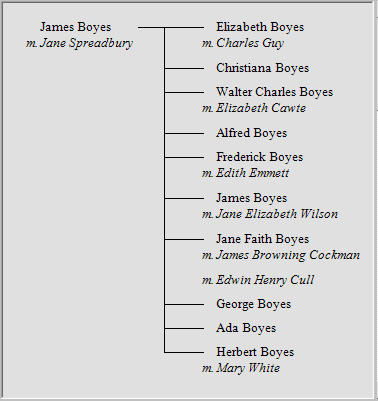
There was an incident in 1864 when James’ son-in-law, Charles Guy, the husband of his daughter Elizabeth, became enraged, acquired two pistols,
and threatened to shoot James and his daughter Christiana (also known as Kate). He did actually try to fire one pistol at Kate, but luckily it mis-fired.
He was prosecuted and sentenced to six years of penal servitude. For more information on the case
please read the Newspaper Report of the Trial of Charles Guy.
James and Jane’s son Walter Boyes became a lodging house keeper near Christchurch and later a farmer in Wellow.
Frederick became a railway porter and lived in Bishopstoke.
James moved to the the London suburb of Putney where he worked as a railway porter and then to Fulham where he worked as a dairyman.
Jane married a local man called James Cockman who was a brick maker. They lived in Twyford and had four children before he died in 1887. Six years later she married Edwin Cull; they lived together in Bishopstoke and had two children. She died in 1945.
Herbert was only 14 when his father died. After he married he became a farmer in Eling in Hampshire and then in Cadnam. He died in East Wellow in Hampshire in 1940.
• Eleanor was baptised on the 19th of January 1817. She lived with her parents until she was into her thirties and then, in 1850, she married James Broomfield and lived with him in Southampton, in Bevois Road. But Eleanor died just six years after she married. Her daughter, whom they named Eleanor Jane, then went to live with her aunt Anna who was her grandfather John Boyes’ youngest daughter.
• Charles became a labourer. After he married, he and his wife Charlotte lived at Hurst Common in the south of the parish of Owslebury. Later they moved to Southampton where they lived near the Bevois Castle pub. In their old age they moved to Colden Common which is very near to Owslebury. They had two children - Charlotte and John.
• Edward. John and Faith’s son Edward was also a labourer. He married Mary Withers, who had moved from Romsey to Twyford, a parish adjoining Owslebury, with her parents Charles and Elizabeth. Charles Withers was a cooper. Edward and Mary lodged with her parents in Twyford. Edward died in his forties and had no children.
• Anna was John and Faith’s youngest child. She was baptised on the 3rd of October 1824. When she was in her twenties she left home to work as a house servant for Charles Bailey, a solicitor in Winchester. She became pregnant and had an illegitimate son whom she named George Newlyn Boyes. By 1861 she was living in Fair Oak next door to her brother William; she described herself as a “Private Lady”. Anna married Henry Hawkins, who was a maltster and brewer, and they lived together in Hensting in the parish of Owslebury. Anna and Henry had just one child, John, and Anna’s illegitimate son George lived with them. In 1871 young George was working as an agricultural labourer even though he was only thirteen years old. Anna died in Owslebury some time in the 1870s.
Return to Sidney Parsons’ Ancestors
You are free to make use of the information in these web pages in any way that you wish but please be aware that the author, Mike Parsons, is unable to accept respsonsibility for any errors or omissions.
Mike can be contacted at parsonspublic@gmail.com
The information in these web pages comes from a number of sources including: Hampshire County Records Office, Somerset Heritage Centre; Dorset County Records Office; Southampton City Archives; the General Register Office; several on-line newspaper archives; several on-line transcriptions of Parish Register Entries; and several on-line indexes of births, marriages and deaths. The research has also been guided at times by the published work of others, both on-line and in the form of printed books, and by information from personal correspondence with other researchers, for all of which thanks are given. However, all of the information in these web pages has been independently verified by the author from original sources, facimile copies, or, in the case of a few parish register entries, transcriptions published by on-line genealogy sites. The author is aware that some other researchers have in some cases drawn different conclusions and have published information which is at variance from that shown in these web pages.
Copyright © 2016 Mike Parsons. All rights reserved.