 Sidney Alfred Parsons and his Ancestors
John Slade (1790 to 1832)
John Slade was Sidney Parsons’ mother’s maternal grandfather. His granddaughter Harriet married John Parsons, the Southampton publican who was Sidney’s father.
John was baptised in Millbrook, near Southampton in Hampshire, on the 25th of July 1790, the eldest son of James and Sarah Slade.
Southampton’s growth as a modern port began during the middle part of the 18th century. By the 1750s much of England’s wine imported from Portugal, formerly handled by London, was coming through Southampton. Other business followed. Coal began to be brought in from Newcastle and trade with the Channel Islands grew. Troop movements during the Napoleonic wars brought money into the town and fuelled its growth. The port continued to grow into the 19th century with timber from the Baltic, grain, building materials, and fruit from Portugal and Spain. The town’s quays were no longer sufficient and between 1838 and 1842 the first dedicated dock was built.
Millbrook today is a western suburb of Southampton. But when John Slade was born it was a rural and thinly populated parish outside Southampton and it included the districts of Shirley and Freemantle. As Southampton expanded Shirley became populous enough to become an independent Parish, and later Freemantle did so as well. In 1895 both Shirley and Freemantle were officially subsumed into the Borough of Southampton. The rest of Millbrook followed, but not until 1954.
John Slade grew up in Millbrook in at the end of the 18th century and the beginning of the 19th. His parents had three other children; two boys, Edward and James, and a girl, Anne, who died in 1802 aged only nine.
John married Martha Wheeler, who was also from Millbrook, on the 1st of November 1808. They moved to Alverstoke, near the mouth of Portsmouth Harbour, but Martha died the following May. In 1812 John married again. The ceremony was held on the the 5th of July 1812 at St Mary’s Church in Alverstoke. His bride was Mary Diaper who had moved to Alverstoke with her sister Rosetta from the village of Hamble which is a few miles west of Alverstoke along Southampton Water. Their father Thomas Diaper was an inn-keeper who was the landlord of the Bull’s Head there.
Three years later Mary’s sister Rosetta also got married in St Mary’s Church — her husband was John Grace who, like her, came from Hamble.
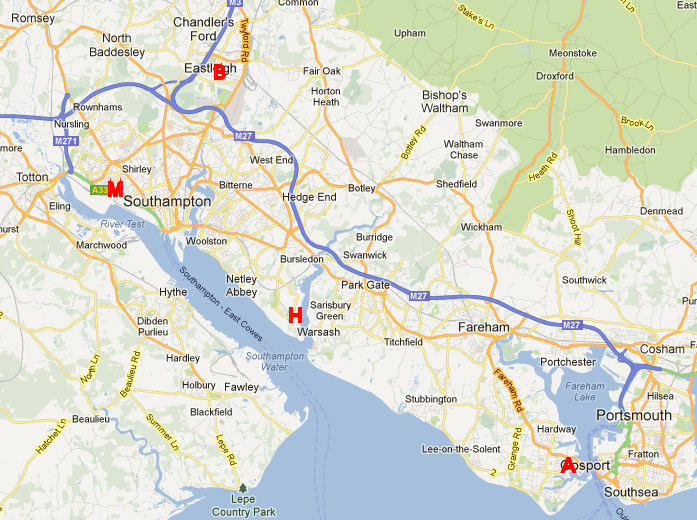
The map on the left shows important places in John Slade’s life.
Alverstoke is marked with a red A, Millbrook with a red M, Hamble with a red H, and Bishopstoke, where John Slade eventually settled, with a red B.
Alverstoke is near the the Royal Clarence Yard which was established on the shore of Portsmouth Harbour in 1783 on the site of an old brewery, and grew during the Napoleonic wars to become the Royal Navy’s main victualling depot. John Slade, John Grace, and the Diaper sisters moved to the area during the yard’s period of most rapid growth. John Grace and the Diapers would probably have found it very easy to get employment because their home village, Hamble, was a seafaring and ship-building centre. The Elephant, Nelson’s flagship at the Battle of Copenhagen had been built there in 1786. And the Diaper family, originally from Itchen Ferry, which faced Southampton across the Itchen River, and just a few miles from Hamble, was well known for its connections with the sea with almost all of its residents having strong maritime connections.
John Slade with his wife Mary, and John Grace with his wife Rosetta, went to live in Hamble, where John Grace and the two women had been born. John Slade worked there as a shipwright and John Grace became a baker at first — he probably inherited the business from his father. Later, John Grace became an inn-keeper, like his father-in-law, and kept the Victory Inn (which is still a popular pub today).
The two Johns were brothers-in-law and became good friends, with John Grace eventually being appointed an executor of John Slade’s, will. He also became an executor of John Slade’s father’s will, James Slade, who still lived in Millbrook.
John and Mary Slade’s first three children, Caroline, Mary Ann, and Harriet were born in Hamble. Harriet was to become Sidney Parsons’ grandmother.
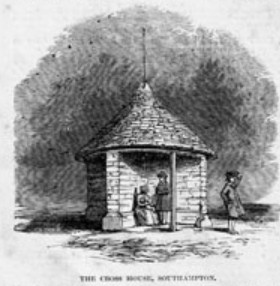
By 1819, when their son John was born, John and Mary had moved to Southampton. They lived in the Cross House area and at first John still worked as a shipwright. But his father died at about this time and he inherited some property. John was familiar with the licenced trade because his wife Mary’s father had been a publican in Hamble, and so was his brother-in-law and friend, John Grace who kept the Victory Inn there. John became an inn-keeper and kept the Swan Inn by the Cross House, in the parish of St. Mary’s.
The illustration on the right shows the Cross House in Southampton in about 1848.
The Cross House was built as a shelter for people waiting for the ferry across the river Itchen which took travellers to the main road to Portsmouth. This was an important part of old Southampton. There was an annual ceremony here where the boatmen of Itchen did homage to the Corporation of Southampton for right of ferry.
The Swan Inn was near the ferry and would have picked up plenty of trade from travellers, sailors and dock workers. Mary, being descended from the Diaper families of the village of Itchen Ferry, just across the river, would have had relatives living there.
John was prosecuted in April 1824 following a raid by Customs and Excise. He was discovered to have a store of smuggled liquor. He was fined £25.
In 1825, while he was the keeper of the Swan Inn, John was prosecuted as an accessory to a theft. George Chudleigh, the mate of the schooner Liberty of Brixern, George Hoskins, an apprentice, and Michael Gough, a seaman were accused of stealing three bushels of oats from the ship. Gough turned King’s evidence and said that he, Hopkins and Chudleigh had agreed to sell the oats to John Slade in exchange for beer, and that Slade had provided a sack and the key of his out-house in which to hide the oats. John Slade was bailed for a total of £200 to appear at the quarter sessions. It is not known what the eventual consequences were for John.
John and Mary had three more children, Elizabeth, Sarah and William, while they were living in Southampton.
In the late 1820s John bought the Anchor Inn in Bishopstoke which is a few miles north of Southampton. They were living there when their last child, Emily, was born. John also bought several shops in Southampton.
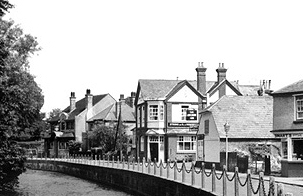
The picture on the left shows the Anchor Inn in Bishopstoke in about 1955. The pub stood alongside the River Itchen, between Winchester and Southampton. The building shown appears to be late Victorian and must have been built on the site of the earlier pub in which the Slade family lived.
The Anchor Inn no longer exists, having been converted into flats and a doctor’s surgery.
When John Slade died at the Anchor Inn on the 23rd of May 1832 he was barely 42 years old. He left a will. It mentioned “the messuage or dwelling house where I now reside at Bishopstoke known by the name of the sign of the Anchor” and went on to list his shops in the Southampton area. They were in East Street, Bedford Place, and Redbridge Lane in Millbrook. They were all heavily mortgaged. John had appointed his brother-in-law John Grace from Hamble and his brother Edward, who still lived in Millbrook, as executors of his will.
John Slade’s property was put up for auction on the 26th April 1833. Coincidently, the auction was held at the Blue Boar Inn, East Street, Southampton, of which John Parsons (who would later marry John Slade’s granddaughter) later became the proprietor. As well as the pub and shops, the property to be sold included two houses in Millbrook which were let to tenants.
The Anchor was not sold at the auction and neither, it seems, were the houses in Millbrook. Many years later, in 1871, William Boyes, the husband of John’s daughter Harriet, sold one of them, Cock Roads Farm in Hill Lane, to the husband of Elizabeth, another of John’s daughters.
After John Slade’s death, Mary continued to live at the Anchor and ran it with the help of her son John. She died some time during the 1850s.
Children of John and Mary Slade
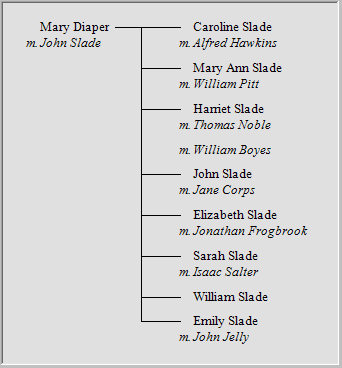
John Slade and his wife Mary had eight children — Caroline, Mary Ann,
Harriet, John, Elizabeth, Sarah, William and Emily.
Their daughter Harriet was a grandmother of Sidney Parsons’ and a great great-grandmother of the present author.
Caroline Hawkins née Slade
Caroline was baptised in Hamble on the 9th of December 1813 while her father was still working as a shipwright. She was brought up there and in Southampton at the Swan Inn, but when she was about 15 years old the family moved to Bishopstoke where they lived at the Anchor Inn.
Caroline’s father died when she was 19 years old and four years later when she married a Bishopstoke man called Alfred Hawkins her mother was one of the witnesses at the wedding.
Alfred worked on the railways as a labourer. He and Caroline lived in Bishopstoke for over ten years and had three children there (Elizabeth, Caroline and Mary). Then they moved to Southampton where their son John was born and then Gosport where, in 1859, their youngest chile Jane was born. By 1871 their children had all left home and they were living in Southampton. Alfred was by then a fireman on railway locomotives.
After Alfred retired he and Caroline stayed for a while in Kennington in London with their daughter Jane and her husband William Clements. Caroline died in Southampton in the latter part of the year 1895, Alfred a year later.
Mary Ann Pitt née Slade
Mary was about eighteen months younger than her sister Caroline; she was baptised in Hamble on the 6th of April 1815.
In February 1837 she married man called William Pitt who worked at his father’s brass foundry in French Street in Southampton. Mary’s younger brother John became an apprentice at the same foundry.
William did not remain a Brass Founder for long; after his father died in 1838 he became a pub landlord instead. His pub was the Shakespeares Head which, like the foundry, was in French Street, and he and Mary lived there for the rest of their lives. His licence allowed him to sell only beer, not spirits, and in 1864 he was prosecuted for selling brandy but he was lucky to be found innocent on a technicality.
Mary and William had no children.
Harriet Boyes formerly Noble née Slade
Harriet was also born while her parents were living in Hamble and she was baptised there on the 20th of April 1816. She was only about sixteen when her father died while the family were living at the Anchor Inn in Bishopstoke. She got married when she was twenty one or twenty two years old to a local man called Thomas Noble. About a year later Thomas died and very soon afterwards their son was born. Harriet called him Thomas after his father. Harriet went back with her child to live at her mother’s pub where they stayed in the out-house.
Four years later Harriet got married again, to a local widower called William Boyes. He was a timber carrier and later became a farmer. They lived in Colden Common for the rest of their lives. Their daughter Harriett, who was born in 1852, became Sidney Parsons’ mother.
Harriet’s husband William had been reasonably well off but in later life he lost most of his money and was unable to pay his bills. (Two of his sons claimed that their brother had squandered it.) Forced to rely on the benefits system of the time he ended up in the Winchester workhouse where he died in 1886.
Harriet died in the Union Workhouse in West End, Southampton in 1893 and was buried in Colden Common. (The Workhouse in West End would later become Moorgreen Hospital).
John Slade
John was born in Southampton while his father was still working as a shipwright. The family were living in Bishopstoke, and he was only about thirteen when his father died.
He was apprenticed to William Pitt, a brass founder, whose workshop was in Southampton at 47 French Street. John’s sister Mary’s husband was William Pitt’s son and he also worked there.
Mr. Pitt made “lifting pumps, beer engines, brass fronts for windows, and all kind of metal work for yachts and vessels”. When Mr. Pitt died in mid summer 1838 his wife Judith decided to continue running the business with the help of her foreman, but John then left even though he had not completed his apprenticeship. Mr. Pitt’s son William also left, deciding to become a pub landlord instead. Mrs. Pitt was furious at the departure of the apprentice. She placed an advertisement in the Hampshire Advertiser which included the following statement:
“Persons in the trade are hereby cautioned not to employ her apprentice (JOHN SLADE, of Bishop’s Stoke), who left her without any cause, before the expiration of his apprenticeship.”
John went back to his mother’s pub and worked there until at least 1841. In 1844, when his sister Harriet married William Boyes, he was one of the witnesses.
John became a ship’s cook, and for many years spent most of his time away. He did, however, meet a woman and marry her. She was a widow called Jane Corps (née Watts) who lived in Bishopstoke, not far from his mother’s pub. She already had two children and John and Jane then had three children of their own — Alice, Jane and John. During the years of their marriage she lived with the children at several addresses in central Southampton and Swaythling (which was then between Southampton and Bishopstoke but has now been subsumed into Southampton). When John was about 60 years old he gave up the sea-going life and settled down with Jane as a grocer in Swaythling.
Elizabeth Frogbrook née Slade
Elizabeth was also born in Southampton before her father took over the Swan Inn. She grew up there and in Bishopstoke. In 1838, when her sister Harriet married Thomas Noble, Elizabeth was one of the witnesses.
In the spring of 1840, when Elizabeth nineteen or twenty years old, she married Jonathan Frogbrook, a miller who had originally come from Bosham or Chidham in Sussex. The marriage took place in Bishopstoke but the couple went to Winchester where they lived on St. Cross road. Jonathan continued to work as a miller and for a while Elizabeth’s brother William lived with them and also worked as a miller.
Jonathan and Elizabeth stayed in Winchester and Jonathan became a publican as well as a miller. They moved to the Gardener’s Arms in St. Cross where he was the landlord. They had no children and Elizabeth died there in 1868 when she was about 47 years old.
Elizabeth’s younger sister Emily’s husband, John Jelly, had recently died. Emily moved in with Jonathan to be his housekeeper, bringing her young children with her to live there as well.
In May 1871 Jonathan bought some property from his brother-in-law William Boyes. The property was in Millbrook and William’s wife Harriet had presumably inherited it from her father. Jonathan paid £1200.
Jonathan moved to Millbrook and lived at the house he had bought which was Cock Roads Farm in Hill Lane. He died there in 1884 or 1885.
Sarah Salter née Slade
Sarah was born in Southampton at the Swan Inn in about 1823. The family moved to Bishopstoke a few years later, but in 1832 Sarah’s father died. Sarah lived with her mother until about May 1850 when she married Isaac Salter.
Sarah and Isaac had three children - Isaac, Sarah Eliza and John Slade — but Isaac died at about the same time his youngest son, John, was born. Sarah lived with her children in Southampton and worked as a char-woman. When the children left home she lodged with a family for a while and worked as a needlewoman. By 1891 she was living alone in Jessie Terrace in the centre of Southampton.
Emily Jelly née Slade
Emily was born in Bishopstoke, while her parents were living at the Anchor Inn. She was less than 3 years old when her father died.
When she was about 16 years old Emily was assaulted by a man called John Hoad, who was fined 40 shillings for the offence by the magistrate’s court.
Emily became a house servant. In 1851 she was living and working in Bath in the house of a prosperous Irish widow and her daughter.
In about May 1852 Emily married a man called John Jelly in Southampton. They lived in Southampton and had two daughters, Emily and Alice. John died some time in the mid 1860s. When Emily’s sister Elizabeth, who lived in Winchester, died a year or two later she moved in to her brother-in-law’s pub to be his housekeeper, bringing her children with her. After he died Emily lived alone for the rest of her life in Southampton.
Return to Sidney Parsons’ Ancestors
You are free to make use of the information in these web pages in any way that you wish but please be aware that the author, Mike Parsons, is unable to accept respsonsibility for any errors or omissions.
Mike can be contacted at parsonspublic@gmail.com
The information in these web pages comes from a number of sources including: Hampshire County Records Office, Somerset Heritage Centre; Dorset County Records Office; Southampton City Archives; the General Register Office; several on-line newspaper archives; several on-line transcriptions of Parish Register Entries; and several on-line indexes of births, marriages and deaths. The research has also been guided at times by the published work of others, both on-line and in the form of printed books, and by information from personal correspondence with other researchers, for all of which thanks are given. However, all of the information in these web pages has been independently verified by the author from original sources, facimile copies, or, in the case of a few parish register entries, transcriptions published by on-line genealogy sites. The author is aware that some other researchers have in some cases drawn different conclusions and have published information which is at variance from that shown in these web pages.
Copyright © 2013 Mike Parsons. All rights reserved.