 Ancestors of Sonja Lissie Parsons
William Magsfeldt Nielsen and his ancestors
Max Nielsen (as he was known) was the present author’s maternal grandfather and he was Danish. His only child, Lissie, married a British Naval Officer called Frank Edward Parsons. Frank’s father, Sidney Alfred Parsons, was born in Southampton but descended from a line of farmers in Dorset and Somerset. Frank’s mother, Rose Dorothy Bennett, also came from Southampton and most of her ancestors had come from nearby parts of the county of Hampshire. Lissie Parsons née Nielsen thus provided the link between the Danish families briefly described here and the Parsons families who are the main subjects of these web pages.

This picture shows Max with his wife Anna Johanna Nielsen. It was taken in the early 1960s.
William Magsfeldt Nielsen was born on the 6th of September 1905 and baptised on the 3rd of December. The events were recorded in the register of the parish of Korsør and it was noted that Max’s mother, Andresine Petrine Nielsen, was unmarried. Her address was given as 50 Revvey in Korsør. It was also noted that a copy of the entry had been made in the parish register for Grove Sogn which is near Haderup and Karup in central Jutland (roughly equidistant from Holstebro, Viborg and Herning) which was the area in which Max’s mother had been born and grew up.
Korsør is a considerable distance from central Jutland but the town is strategically located on the main route from Jutland to Copenhagen, Denmark’s capital city. Denmark consists of the Jutland peninsula (Jylland in Danish), which extends northwards from Germany, and a number of islands, the largest of which is Zealand (Sjælland) upon which Copenhagen (København) stands. The second largest is Funen (Fyn) which lies between Zealand and Jutland. Korsør is in the west of Zealand at the point where a ferry carried travellers from Copenhagen to Funen (Fyn) where the main road continued to a second, much shorter, ferry crossing to Jutland. Today both ferries have been replaced by bridges.
The parish register entry for Max’s birth named his father as Vilhelm Nielsen but he was usually known as William.
He probably never married Andresine Petrine Nielsen but he was her partner for many years and had five children with her.
In addition to Max there was another boy, called Jens, and three girls who were called Karen, Thora and Marie. Karen was the oldest child and Max the
second oldest. William was not a reliable father and husband. He would often disappear for months at a time leaving his family to fend for
themselves.
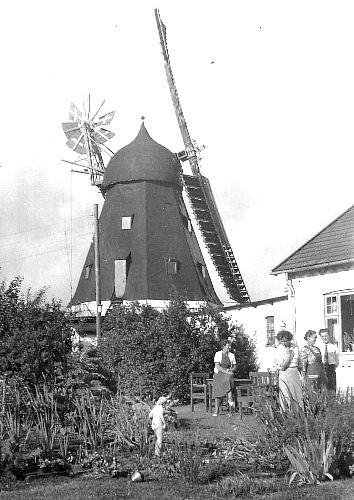
Max had little formal education but when he left school he went to work at a mill in Gedsted, a small village in the north of Jutland. It is about 20km north of Viborg and lies near the waters of the Limfjord in a quiet rural area. The mill (Gedsted Mølle) was a traditional wooden windmill situated on a low mound near the centre of the village but it has long since been demolished. When the author last visited Gedsted there was no sign of it except for a model windmill in the garden of a house near where the real mill had once stood.
While Max was working in Gedsted he became friendly with the miller’s son, Johannes Jensen, who eventually inherited the mill, and he and Max remained good friends for the rest of their lives. Max’s daughter Lissie would spend her summer holidays at the mill and many years later Johannes and his wife Marie visited Lissie and her husband in Gosport on the south coast of England.
The picture shows Gedsted Mølle in the 1950s. Max’s wife Anna can be seen sitting perched on a table.
Like all other young men in Denmark at that time Max had to spend a period of time in military service and he was posted to
a barracks near Copenhagen. While he was there he met his future wife Anna Johanna Nielsen. She became pregnant
and in 1927 they married. Six weeks later their only child, a girl called Lissie, was born.
After Max and Anna married they lived with her parents, Søren and Bertha, in Husum which was then on the north-western edge of Copenhagen. They had a house in Haraldstedvey and, on the opposite side of the same road, a grocer’s shop. Max worked at the Frihavn docks where he was employed on a day-to-day basis while he looked for a better job. He applied to the police and the fire service but he was eventually accepted as a street-car driver for the Copenhagen tramways, a job of which he was very proud.
Max had a fine bass singing voice and joined the company’s choir, travelling with them to competitions with other Scandinavian choirs.
After Anna’s father died Max re-built the house in Husum. It was a wooden structure but he reconstructed it using reclaimed bricks which the family cleaned by hand. He also installed hot running water and central heating, luxuries which the family had not been used to, but before they could use them Denmark was invaded by German troops and regulations were introduced restricting energy use.
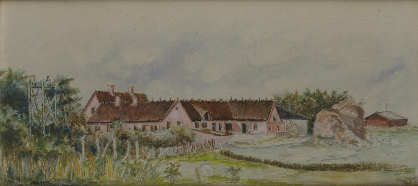
During the German occupation Max and his family took a holiday to the north coast of Zealand where they stayed near Tisvildeleje in a small basic summerhouse. They did not have permission to travel that far so they made the journey by bicycle on minor roads. When they arrived they found that the summerhouse was overlooked by a German watch tower on the farm behind it. Whether or not their presence was noticed, nothing was said. The summerhouse was at the end of a short cul-de-sac called Sogneskellet which ran through a piece of land large enough to build six houses. Max decided to buy the summerhouse with its land and had it legally divided into separate plots keeping the existing summerhouse at Sogneskellet no.5 for himself. On one plot he built a new summerhouse for his sister Thora but there was a disagreement over payment for it which led to long-standing bad feeling between them. Years later Max upgraded his summerhouse once again, to a good modern standard, and he and Anna kept it for the rest of their lives.
The painting shows the farm Tisvildegård as seen looking south-westward from Max’s summerhouse.
Max bought a block of six apartments in Copenhagen. It was in Hildursgade, near Haraldsgade in the Nørrebro district.
He and Anna lived in one of them and the others were rented out. However Max found that being an on-site landlord
could be rather trying so he sold the block, but he and Anna stayed on there as tenants. He retired from his job as a street-car driver on
health grounds after which he supplemented his pension by doing odd jobs. He and Anna would spend their summers in their
summerhouse and their winters in Copenhagen.
Max and Anna’s only child Lissie married Frank Parsons, an officer of the British Royal Navy who was a son of Sidney Alfred Parsons thus creating a link between the Danish familes described here and the Parsons families of Somerset and Dorset from whom Frank and Sidney were descended.
Max died in hospital in Copenhagen in November 1984 and Anna died in 1997 in a care home.
Max Nielsen’s ancestors
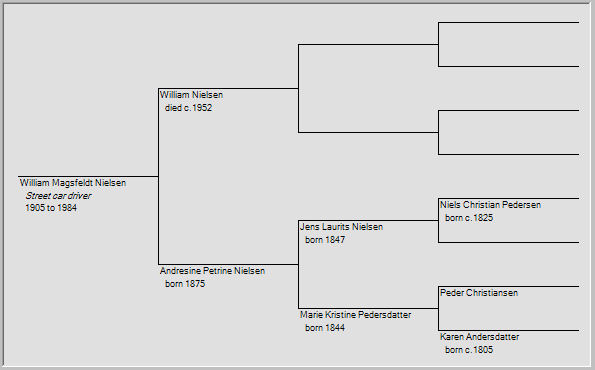
Parents
• William Nielsen, Max’s father, lived a colourful life and was something of a rogue, but his life seems to have been poorly documented. For some years he and his ‘wife’, whom he probably never married, provided catering services for road and railway building gangs, travelling around Denmark wherever they were working. There is a family rumour that he invented a bottle-washing machine which could have made him wealthy but he sold all rights to it for a small fixed sum. He would often leave his family, disappearing for months at a time. At Christmas time he would sometimes sell Christmas trees in Copenhagen and on one occasion he cheated his son, Max, who had been working for him, out of his share of the profits. William was also a well known horse trader and when he died in 1952 one of the national newspapers published his obituary. Some of his children Max’s brothers and sisters, lived similarly unstable lives. His son Jens became a seaman and spent much of his leave in the notorious bars of Copenhagen’s Nyhavn district. Marie, William’s youngest child, worked in the bars of Nyhavn and sometimes, in summer, in the bars and restaurants of the adult amusement park at Bakken; she was a drug user and died at a relatively early age.
• Andresine Petrine Nielsen, Max’s mother, was born in the parish of Karup in Jutland on the 8th of May 1875. That part of Jutland consisted mainy of poor quality heathland where most people lived in considerable poverty. Her father was a smallholder and she was the fourth of seven children. By 1890, when she was 15 years old, she was no longer staying with her parents; she had been sent to Copenhagen to work as a kitchen maid. After meeting William Nielsen she spent several years living mostly in temporary accommodation near to the road and rail building gangs for whom she and William provided catering services. Throughout their partnership William was frequently absent. In her later years Andresine lived in Copenhagen and made a living by selling smoked fish door-to-door in the city’s many apartment blocks. She probably also made money in other ways, for example she sometimes procured abortions for unmarried girls who had got ‘into trouble’. Eventually her two eldest children, Karen and Max, persuaded her to leave William and got her settled in her own comfortable apartment. Andresine died suddenly in a care home in Copenhagen in the mid 1950s while she was on her way to visit a male friend.
Grandparents
• Paternal grandfather — unknown
• Paternal grandmother — unknown
• Jens Laurits Nielsen was Max’s maternal grandfather. He was born in Hjørring in north Jutland on the 18th of June 1847. He married his wife Karen in Karup on the 24th of March 1870 and their seven children — Rebække Caroline, Neils Christian, Frederick Peder, Andresine Petrine, Marie Kristine, Jens, and Laurits were born there.
• Karen Kristine Pedersdatter was Jens Laurents Nielsen’s wife. Her birth was registered in 1844 in Kragelund, in mid Jutland, which is about 20km from Karup where she married Jens, but she always maintained that she had been born in Karup.
Return to Mike Parsons’ genealogy pages
You are free to make use of the information in these web pages in any way that you wish but please be aware that the author, Mike Parsons, is unable to accept respsonsibility for any errors or omissions.
Mike can be contacted at parsonspublic@gmail.com
The information in these web pages comes from a number of sources including: The Danish National Archives (Rigsarkivet), Hampshire County Records Office, Somerset Heritage Centre; Dorset County Records Office; Southampton City Archives; the General Register Office; several on-line newspaper archives; several on-line transcriptions of Parish Register Entries; and several on-line indexes of births, marriages and deaths. The research has also been guided at times by the published work of others, both on-line and in the form of printed books, and by information from personal correspondence with other researchers, for all of which thanks are given. However, all of the information in these web pages has been independently verified by the author from original sources, facimile copies, or, in the case of a few parish register entries, transcriptions published by on-line genealogy sites. The author is aware that some other researchers have in some cases drawn different conclusions and have published information which is at variance from that shown in these web pages.
Copyright © 2017 Mike Parsons. All rights reserved.