 Sidney Alfred Parsons and his Ancestors
Judge Francis Dart Fenton of New Zealand
Judge Fenton’s connection to the Parsons family is through his son Carleton Hugh Fenton who married Margaret Grace Parsons, a grandaughter of Henry Parsons. Margaret’s father was Henry John Donne Parsons and she was a third cousin of Sidney Alfred Parsons.
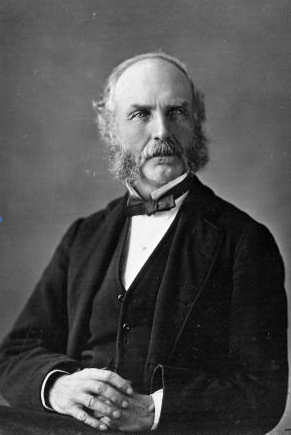
Francis Dart Fenton was born in Holloway, Islington, in London where he was baptised on the 6th of August 1824. His father, Francis Tarrant
Fenton, was a solicitor who was originally from Yorkshire but practicing in London. In 1844 Fenton joined his uncle James Crossland Fenton’s law office
in Huddersfield where he qualified as a solicitor. He remained in Huddersfield, where he lived in the Lockwood district, until 1850 when he left
for New Zealand.
At first Fenton rented land on the south bank of the Waikato River in North Island, near the river’s mouth. He became well acquainted with the customs and language of the Maori people. After a while he met the Governor of the colony, Sir George Grey, who offered him a position in the Registry of Deeds which led to a succession of official appointments. In 1857, with the support of Maori leaders, he became a magistrate at Waikato during a time when their relationships with the European settlers had become difficult. During that appointment he was asked to prepare a draft of a Maori Book of Laws.
In 1865 Fenton was asked to draw up the Native Lands Act and became Chief Judge of the Native Land Court, a post which he held for seventeen years. After the establishment of the court the Native Department, which had been the government’s land purchasing office, lost most of its powers, and its senior official, Donald McLean, whose policies Fenton had criticised, resigned. However McLean was elected to the House of Representatives in 1866 and became Native Minister in 1869. For nearly half of Fenton’s term as chief judge McLean, with whom his relationship continued to be difficult, was his minister. The court, which applied European legal principles to matters which had previously been dealt with by Maori customary law, had the unfortunate effect of breaking up communally owned land into smaller parcels which could be individually sold. It facilitated the transfer of Maori land into European ownership.
For a few years Fenton sat on the New Zealand Legislative Council for which he had to give up his role of Chief Judge of the Land Court. Later he became a district judge for Auckland. He retired from public service in 1882.
In his private life, Fenton had a keen interest in music and played the violin and cello. He was a founder of the Auckland Choral
Society and he remained its president until his death. It was largely through his efforts and influence that the Choral Hall was built, and he remained
president of the society until his death.
On the 9th of December 1858 Fenton married Martha Connell. They had four daughters and two sons.
Many people admired Fenton’s good humour and found him to be a pleasant companion. Others saw a different side to his character. William Gisborne, who worked with him for nearly 30 years, wrote that he was “a hard man to get on with unless he had his own way; he was cold, rather cynical, self-confident, uncompromising, and obstinate in his dislikes”.
About 10 years before his death, Fenton acquired some land in the Kaipara district, north of Aukland, where he established a vinyard. He had a strong belief that wine-producing would become an important part of the economy of the area.
Fenton died in Auckland on the 23rd of April 1898 having moved there from his Kaipara estate in order to be closer to medical help. He was survived by his wife
You are free to make use of the information in these web pages in any way that you wish but please be aware that the author, Mike Parsons, is unable to accept respsonsibility for any errors or omissions.
Mike can be contacted at parsonspublic@gmail.com
Copyright © 2017 Mike Parsons. All rights reserved.