 Sidney Alfred Parsons and his Ancestors
The Donne Family of Crewkerne
The connection between the Parsons and Donne families began in 1851 when Henry Parsons, a son of George Parsons of Charlton Horethorne, married Elizabeth Mary Merefield Donne.
Sidney Alfred Parsons and Henry Parsons were cousins twice removed, their most recent common ancestor being William Parsons of Holton who lived from 1751 to 1837.
Elizabeth Mary Merefield Parsons née Donne (1830 to 1897)
Elizabeth Donne was born in Bristol in 1830, the eldest child of Benjamin Donne, an accountant, and his wife Ann (née Yandell). She had a brother, called Benjamin after his father, who was a year younger than her. Elizabeth and Benjamin’s father had the same name as a celebrated mathematician and map maker who lived and worked in Bristol but was not closely related to him, if at all.
In October of 1831 there were severe civil disturbances in Bristol following the defeat of the Reform Act which would have given Britain’s newer industrial towns, including Bristol, proper representation in parliament. During the Queen Square riots, as they became known, the Mansion House was severely damaged, the gaol torn down, and many private properties destroyed, damaged or looted. Elizabeth’s father Benjamin somehow became involved and was tried with about 100 other men at the Special Commission in early January. He was convicted of stealing a brass weight, the property of His Majesty, and sentenced to be imprisoned for one year. From that time on it seems that the two children no longer lived with their parents.
Crewkerne in Somerset was the ancestral home of the Donne family and an elderly relative of the children lived there. Mrs Anna Maria Susanna Donisthorpe was a grandaughter of John Donne (1696 to 1768) who had been a steward to the wealthy land-owner Lord Poulett and the two children were descended from a younger brother of his. Mrs Donisthorpe had no children of her own and, just three years after she married, her husband had been convicted of a serious assult and imprisoned for two years. Years later, long after her husband had died, Mrs Donisthorpe was sympathetic to the two children whose father had been imprisoned and she arranged for them to be baptised in Crewkerne, which was done on the 8th of August 1840. The baptismal register noted that the children’s father was “now residing in the United States, if alive”.
In 1841 young Elizabeth and Benjamin were living in Bristol, in the home of their mother’s un-married sister Charlotte, but soon afterwards Mrs Donisthorpe took them in and effectively adopted them, making them joint heirs to the considerable fortune she had inherited.
Elizabeth and her brother were brought up in Merifield House which was, and still is, in East Street in Crewkerne.
On the 28th of January 1851 Elizabeth got married. She was not yet 21 years old. Her husband was Henry Parsons who was a farmer, land agent, and steward to Lord Portman. The wedding was in Haselbury Plucknett, a village just to the north-east of Crewkerne, and the witnesses were Elizabeth’s brother Benjamin and John Weston Peters and his wife Ezit who were friends of the Parsons family.
Elizabeth and Henry lived in Haselbury Plucknet for many years and all of their children were born there. Their home was Haselbury House.
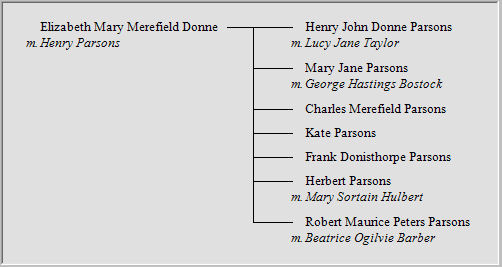
Elizabeth and Henry had seven children :
• Henry (1851 to 1906) became a land agent like his father and eventually settled in Devon.
• Mary (1853 to 1936) married an estate agent called George Bostock and moved to Windsor in Berkshire.
• Charles (1854 to 1881) died at sea off Spencers Gulf in South Australia.
• Kate (1855 to 1933) never married. In later life she settled in Minehead in Somerset.
• Frank (1856 to 1911) became a civil engineer. He never married.
• Herbert (1859 to 1932) was a solicitor and moved several times. In later life he lived in Willesdon, Middlesex.
• Robert (1860 to 1947) became a land agent and surveyor. He lived for most of his life in Misterton.
For more information about Elizabeth and Henry’s children and grandchildren click on the following link — Elizabeth and Henry’s children
Late in the 1870s Elizabeth and Henry moved from Haselbury Plucknett to Misterton which is about two miles to the south-west.
There they lived in the manor house which Henry purchased from Lord Portman.
In 1895 Henry became ill and after about two months he died. A memorial service was held in Misterton after which his body was taken by train to Woking where it was cremated.
Elizabeth continued to live in the manor house in Misterton until, just over a year after her husband, she died. She was buried in Misteron.
Benjamin John Merefield Donne (1831 to 1928)
Benjamin was Elizabeth Mary Merefield Parsons’ brother. Like her he was born in Bristol and later informally adopted by Mrs Anna Maria Susanna Donisthorpe.
In 1854 Benjamin married Jane Bradley, a clergyman’s daughter who also lived in Crewkerne. A year later their first child was born in Crewkerne and they named her Anna after Mrs Donisthorpe. About a year later Mrs Donisthorpe died; Benjamin became independently wealthy and he and his family moved to Axmouth near Seaton in Devon.
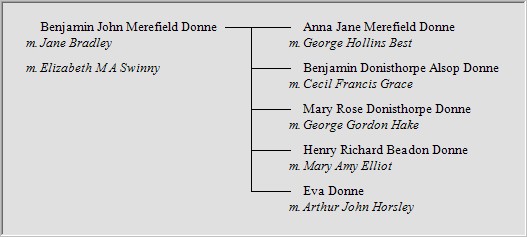
Benjamin and Jane had five children. Their eldest daughter Anna married George Hollins Best who was a captain in the Gordon Highlanders.
Their two sons both joined the army and retired with the rank of Colonel. They both painted in watercolours, as did their father, and their work is still sought after today.
Mary married George Gordon Hake who worked for a railway company in Nyasaland (now Malawi) and died there in 1903. Mary died in 1952 at her daughter and son-in-law’s home in Shaftesbury in Dorset.
Benjamin and Jane’s youngest child, Eva, was born in 1863. She married an officer in the Royal Navy but passed away less than three years later. Her husband reached the rank of Rear Admiral before he retired. Their son Roland had a distinguished military career and was awarded the Military Cross.
Benjamin’s wife Jane died in 1898 and year later he married Elizabeth Swinney at St George’s, Hanover Square, in London.
Benjamin died in April 1928 and was buried in Axmouth. A local newspaper reported that — “The funeral took place at Axmouth on Saturday of Mr B. J. M. Donne, who passed away at 9, Louisa-terrace, Exmouth, within three months of his 97th birthday. Deceased was a native of Crewkerne but had spent a great deal of his life as Axmouth, Torquay and Exmouth. He was a water-colour painter of considerable merit. He was also keenly interested in yachting and yacht building”. The report also noted that “the mourners included Colonel H.R.B. Donne C.B. C.M.G. (son) Mrs. Gordon Hake (daughter), Admiral Horsley R.N. (son-in-law), Mr. & Mrs. G.D. Gordon Hake (grandson & grandaughter), Mrs. Neville Shaw (grandaughter), Mr William Shaw (great-grandson), Mr. Maurice Parsons (nephew), Mr. W.Peters and Major Sherwell (cousins)”.
Anna Maria Susanna Donisthorpe née Donne (1770 to 1856)
Anna Maria Susanna Donne, who was born in Crewkerne on the 1st of May 1770, was the heir to a substantial part of the Hewish Manor estate which had been owned by the Merefield (or Merifield) family since Robert and Elizabeth Merifield had bought it in 1557.
The following chart shows a few generations of her ancestors:
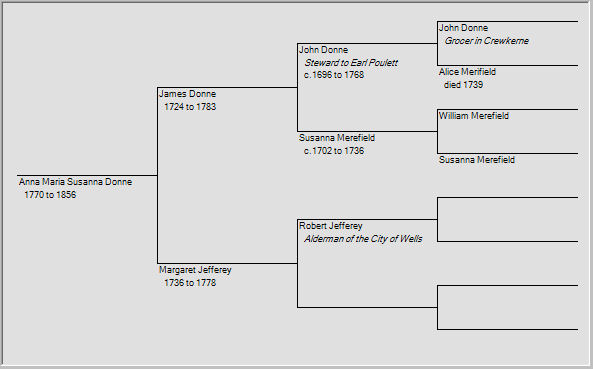
The manor passed down through generations of Merifields until it was inherited by two sisters — Alice (wife of John Donne, a Crewkerne grocer)
and Susanna (wife of William Merifield of Woolminstone).
A dispute led to the manor being divided into three parts. One part was eventually bought by Lord Poulett and became part of his estate. Another part passed to John Donne of Crewkerne, Lord Poulett’s steward, and eventually to his grandaughter Anna Maria Susanna Donne. The final part passed to the widow of Alice and Susanna’s half brother John Merifield.
The house in Crewkerne in which Anna lived, Merifield House, is on the north side of East Street. It had been built in 1589 by Robert Merefield. Anna had originally inherited it jointly with her sister Mary in 1783 when their father died, but Mary had died in 1799 leaving her share to Anna.
Anna lost both of her parents while she was still a young girl. She was only eight when her mother died and her sister Mary
was six. Nine months later their father James got married again, to Grace Brooks, but three years later she died. A year after that James
died leaving the two young girls as orphans. On reaching their majority the girls gained control of the estate but when Mary died having only
just reached 27 years of age it became Anna’s alone.
As a young unmarried woman Anna lived with a relative called John Donne in the village of Puckington, near Ilminster, and there, three months before her sister Mary died, she married. Her husband was the Reverend George Donisthorpe of Norton-sub-Hamdon and their wedding was on the 26th of March 1799. George’s father and paternal grandfather, both called George Donisthorpe, came from the village of Evershott in Dorset. His grandfather had been Steward to Lord Ilchester of Melbury Sampford in Dorset and the large house called Donisthorpe House in Somerton was built for him although he maintained a home in Evershott too.
After they married Anna and George lived in Crewkerne.
In 1803 Anna’s husband was convicted of a serious assult which was widely reported in the newspapers. The reporters declined to give details saying only that it was “of a most detestable nature” with the details being “wholly unfit to meet the public eye”. George was imprisoned for two years. He was also sentenced to be placed in the pillory but that part of his punishment was remitted because, the judge said, the fury of the public would endanger his life. One newspaper noted that “the prisoner has only been married three years to a very engaging female, who, together with a very respectable acquaintance, are likely to suffer in the indiscriminate disgrace of this man‘s character”.
Upon his release from prison George returned to Crewkerne where he died in 1825. He and Anna had no children.
Anna took an interest in two children who were descendents of her grandfather, John Donne, who had lived from 1696 to 1768. They were Elizabeth Donne and Benjamin Donne. Their father had been imprisoned after the Queen Square riots in Bristol and they were living with their mother’s un-married sister. They had never been baptised so Anna arranged for that to be done in Crewkerne and then she took them in and treated them as though they were her own children.
Anna died in April 1856 and was interred in the Donne family vault in Puckington, where she had lived when she was a young lady.
Anna left the majority of her estate to her informally adopted children Elizabeth Mary Merefield Donne (who was by then married to Henry Parsons) and Benjamin John Merefield Donne.
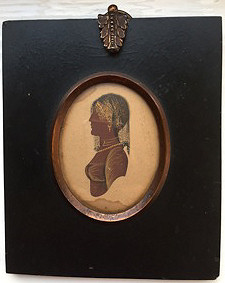
The commemorative photograph shown on the left was produced as a memorial and is still in the hands of the descendants of Anna’s adopted daughter Elizabeth. An inscription on its reverse identifies it as Ann Maria Susannah Donne Donisthorpe.
In 1920 Benjamin John Merefield Donne gifted some land to Crewkerne Urban District Council for use
as a public park. The land is today known as the Bincombe Beeches nature reserve.
Return to Sidney Parsons’s Ancestors
You are free to make use of the information in these web pages in any way that you wish but please be aware that the author, Mike Parsons, is unable to accept respsonsibility for any errors or omissions.
Mike can be contacted at parsonspublic@gmail.com
The information in these web pages comes from a number of sources including: Hampshire County Records Office, Somerset Heritage Centre; Dorset County Records Office; Southampton City Archives; the General Register Office; several on-line newspaper archives; several on-line transcriptions of Parish Register Entries; and several on-line indexes of births, marriages and deaths. The research has also been guided at times by the published work of others, both on-line and in the form of printed books, and by information from personal correspondence with other researchers, for all of which thanks are given. However, all of the information in these web pages has been independently verified by the author from original sources, facimile copies, or, in the case of a few parish register entries, transcriptions published by on-line genealogy sites. The author is aware that some other researchers have in some cases drawn different conclusions and have published information which is at variance from that shown in these web pages.
Copyright © 2013 Mike Parsons. All rights reserved.